
TL;DR:
- Cloud computing is a comprehensive operational platform that enhances agility, security, and business transformation.
- Successful cloud adoption depends on strategic planning, clear objectives, and understanding service models like SaaS PaaS and IaaS.
- Effective cloud strategies improve efficiency, security, and innovation when paired with strong processes and experienced guidance.
Most corporate leaders assume cloud computing is just a fancier way to store files. That assumption is costing UK businesses real money and competitive ground. Cloud computing is a full operational platform that reshapes how organizations process data, deploy applications, collaborate across teams, and protect sensitive information. For IT managers and decision-makers navigating digital transformation, understanding what cloud truly offers is the difference between incremental improvement and genuine business reinvention. This article breaks down cloud computing's real role across efficiency, security, and transformation, giving you a clear framework to evaluate your next move.
Table of Contents
- Understanding cloud computing: Beyond storage and servers
- Driving digital transformation: Cloud as a catalyst for change
- Enhancing efficiency: Streamlining operations with cloud solutions
- Strengthening security: Cloud strategies for UK enterprises
- Our perspective: Why cloud isn't a magic bullet — and what really works
- Discover how Mighty Sky Technologies accelerates cloud transformation
- Frequently asked questions
Key Takeaways
| Point | Details |
|---|---|
| Cloud is more than storage | Cloud computing provides a platform for scalable, agile business innovation, not just basic tech infrastructure. |
| Accelerates digital transformation | Cloud enables rapid deployment of digital workplaces, supporting modernization of legacy systems and boosting UK enterprise productivity. |
| Drives efficiency and savings | Cloud adoption streamlines operations and cuts infrastructure costs, empowering IT managers with flexible and analytics-driven solutions. |
| Strengthens security posture | Advanced cloud security protocols help UK organizations stay compliant and resilient against evolving cybersecurity threats. |
Understanding cloud computing: Beyond storage and servers
Cloud computing is not a single product. It is a delivery model for technology resources accessed over the internet, on demand, without owning physical hardware. Cloud computing encompasses software, storage, analytics, and networking, all managed remotely and billed based on usage. That scope is far wider than most organizations realize when they first explore migration.
There are three primary service models every IT manager should understand:
- SaaS (Software as a Service): Applications delivered via the internet, such as Microsoft 365 or Salesforce, eliminating local installation and maintenance.
- PaaS (Platform as a Service): Development environments hosted in the cloud, allowing teams to build and deploy applications without managing underlying infrastructure.
- IaaS (Infrastructure as a Service): Virtualized computing resources including servers, storage, and networking, giving organizations maximum control without owning physical hardware.
Each model serves different business needs. A finance team might rely on SaaS for accounting tools, while your development team uses PaaS to accelerate product builds. Understanding which layer solves which problem is the first step toward a coherent cloud strategy.
The biggest misconception we see in UK enterprises is treating cloud as a cost-cutting exercise rather than a capability upgrade. Yes, you reduce capital expenditure on servers. But the real value is in agility: the ability to spin up new services in hours rather than months, scale resources during peak demand, and give distributed teams consistent access to the same tools and data. Reviewing your IT infrastructure options with that lens changes the conversation entirely.
Cloud also enables a shift from reactive IT management to proactive strategy. Instead of your team spending time patching servers and managing hardware failures, they focus on optimizing systems that drive business outcomes. That is a meaningful change in how IT contributes value.
Pro Tip: When evaluating cloud providers, do not anchor on price alone. Assess flexibility in contract terms, quality of technical support, geographic data residency options, and the provider's compliance certifications relevant to your industry.
Driving digital transformation: Cloud as a catalyst for change
Digital transformation is not about buying new software. It is about fundamentally changing how your organization creates and delivers value. Cloud computing is the infrastructure that makes that change possible at scale. Cloud adoption accelerates the reach and scalability of digital transformation initiatives, enabling organizations to deploy new capabilities without waiting on hardware procurement cycles.
For UK enterprises, the stakes are significant. Technology drives £317B in UK business growth, and cloud platforms are central to capturing that opportunity. Organizations that delay migration risk falling behind competitors who are already using cloud-native tools to serve customers faster and more efficiently.
A practical cloud migration roadmap for decision-makers involves these sequential steps:
- Assess your current environment: Catalog existing applications, data volumes, and dependencies before any migration begins.
- Define business objectives: Clarify what transformation means for your organization, whether that is faster product delivery, better customer experience, or reduced operational costs.
- Choose the right cloud model: Decide between public, private, or hybrid cloud based on your security requirements and workload characteristics.
- Pilot with low-risk workloads: Start migration with non-critical systems to build confidence and surface integration issues early.
- Scale and optimize: Expand migration progressively, using performance data to refine your approach and maximize return.
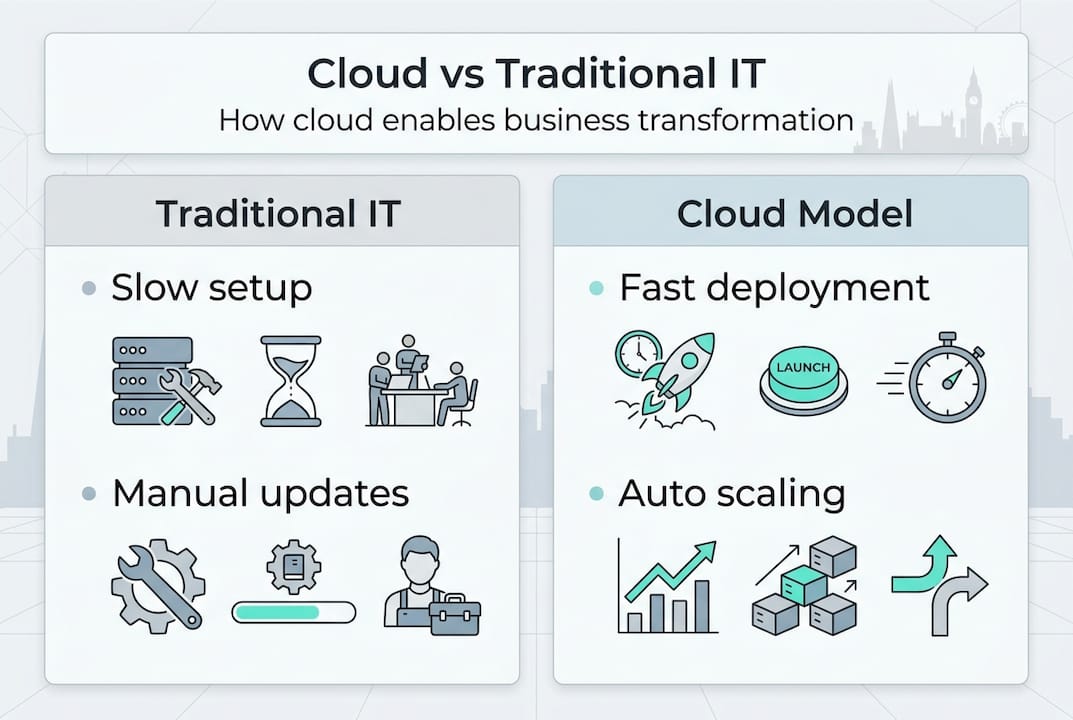
The comparison below illustrates how cloud-enabled operations differ from traditional IT models:
| Factor | Traditional IT | Cloud-enabled || |---|---|---| | Deployment speed | Weeks to months | Hours to days | | Scalability | Limited by hardware | On-demand, elastic | | Cost model | High upfront capital | Pay-as-you-use | | Maintenance burden | Internal IT team | Shared with provider | | Innovation pace | Slow, constrained | Fast, iterative |
Cloud also enables the digital workplace that modern employees expect, with seamless collaboration tools, remote access, and integrated workflows. Organizations that invest in digital transformation efficiency through cloud report faster time-to-market and stronger employee productivity across distributed teams.
Enhancing efficiency: Streamlining operations with cloud solutions
Operational efficiency is where cloud computing delivers some of its most tangible and measurable results. Cloud adoption cuts infrastructure costs, increases agility, and fosters scalable workflows, translating directly into better resource allocation for IT managers.
Here is what that looks like in practice across common enterprise functions:
- Reduced hardware maintenance: No more emergency server replacements or capacity planning headaches. The provider handles physical infrastructure.
- Automated backups and disaster recovery: Cloud platforms offer built-in redundancy, significantly reducing recovery time objectives compared to on-premise setups.
- Elastic storage and compute: Scale resources up during peak periods and down during quiet periods, paying only for what you actually use.
- Centralized management: IT teams manage all environments through unified dashboards, reducing complexity and the time spent context-switching between systems.
The cost difference between legacy and cloud models is often stark. Here is a realistic comparison:
| Cost category | Legacy on-premise | Cloud model |
|---|---|---|
| Hardware purchase | High upfront cost | None |
| Maintenance and upgrades | Ongoing internal cost | Included in subscription |
| Disaster recovery setup | Expensive secondary site | Built-in, lower cost |
| Scaling additional capacity | Weeks, significant spend | Minutes, incremental cost |
| IT staff time on infrastructure | High | Significantly reduced |
For IT managers, this shift means your team's time moves away from keeping the lights on and toward projects that actually advance the business. Reviewing IT infrastructure tips alongside your cloud strategy helps you identify where the biggest efficiency gains are hiding in your current setup. Pairing cloud adoption with a broader plan to optimize business technology ensures you are not just migrating problems from one environment to another.

Pro Tip: Use cloud-native analytics tools to monitor application performance, resource utilization, and cost trends in real time. This data helps you right-size your cloud environment and avoid paying for unused capacity.
Strengthening security: Cloud strategies for UK enterprises
Security is the concern that stops most UK IT managers in their tracks when cloud migration comes up. The fear is understandable. Putting sensitive data outside your own walls feels risky. But the reality is more nuanced, and in many cases, cloud environments offer stronger security than on-premise alternatives.
Cloud providers invest heavily in advanced security protocols and real-time threat monitoring, dedicating resources that most individual enterprises simply cannot match. Major providers maintain teams of security engineers working around the clock, deploying AI-driven threat detection and automated response systems that update faster than any internal patch cycle.
"Security is no longer a reason to avoid cloud. For most UK enterprises, it is becoming a reason to accelerate adoption." This shift reflects growing evidence that well-configured cloud environments outperform legacy on-premise setups in breach prevention and incident response speed.
Security drives cloud adoption among UK enterprises precisely because the threat landscape has evolved. Ransomware, phishing, and supply chain attacks are more sophisticated than ever. Cloud platforms offer layered defenses that are continuously updated, rather than relying on periodic internal reviews.
Key compliance considerations for UK organizations using cloud include:
- GDPR compliance: Cloud providers must offer data residency controls, data processing agreements, and clear audit trails to meet UK GDPR requirements.
- ISO 27001 certification: Look for providers certified to this international standard for information security management.
- Cyber Essentials alignment: UK government-backed framework that cloud configurations should support, particularly for public sector contracts.
- Industry-specific regulations: Financial services firms must align with FCA guidelines; healthcare organizations follow NHS Digital standards.
The key is not whether to trust cloud security, but how to configure it correctly. Shared responsibility models mean providers secure the infrastructure, while your organization secures data access, user permissions, and application configurations. Understanding that boundary is critical for any IT manager leading a cloud program.
Our perspective: Why cloud isn't a magic bullet — and what really works
After working with UK enterprises across sectors, we have seen a consistent pattern. Organizations that rush into cloud adoption focused purely on cost savings often end up disappointed. They migrate workloads without rethinking processes, and they simply replicate old inefficiencies in a new environment.
The uncomfortable truth is that cloud computing amplifies whatever organizational discipline you already have. If your change management is weak, cloud migration will expose that. If your IT governance is unclear, cloud spending will spiral. The technology is not the hard part. The people and processes around it are.
What actually works is starting with a clear business outcome in mind, not a technology goal. The best transformations we have seen begin with a question like "how do we serve customers 30% faster" rather than "how do we move to the cloud." That framing keeps decisions grounded in value rather than technology for its own sake.
Organizations that invest in remote IT support alongside cloud migration also fare better, because they maintain operational continuity during transition periods without overloading internal teams. Cloud is powerful. But it works best when paired with experienced guidance and a realistic plan.
Discover how Mighty Sky Technologies accelerates cloud transformation
If this article has clarified the strategic role cloud computing can play in your organization, the logical next step is finding a partner who understands the UK enterprise landscape and can translate that strategy into real outcomes.
Mighty Sky Technologies Limited delivers enterprise-ready cloud solutions designed specifically for UK businesses navigating digital transformation. From initial cloud readiness assessments to full migration support and ongoing managed services, our team works alongside your IT leaders to build cloud environments that are secure, efficient, and aligned with your business objectives. Whether you are modernizing legacy infrastructure or scaling a cloud-native operation, we provide the expertise and hands-on support to make it work. Reach out to explore how we can help your organization move forward with confidence.
Frequently asked questions
What are the main benefits of cloud computing for UK businesses?
Cloud adoption cuts infrastructure costs and fosters scalable workflows, making cloud computing ideal for UK organizations seeking efficiency gains, greater agility, and the foundation for digital transformation.
How does cloud computing improve security for enterprises?
Major cloud providers invest in advanced security protocols and real-time threat monitoring, offering layered defenses that most enterprises cannot replicate with on-premise infrastructure alone.
Can legacy IT systems be integrated with cloud platforms?
Yes. Cloud migration enables rapid deployment of digital tools alongside existing systems, and a phased migration roadmap helps enterprises modernize without significant disruption to live operations.
What compliance concerns are relevant for UK companies using cloud?
UK companies must address GDPR, ISO 27001 standards, and industry-specific regulations when selecting cloud providers. Security drives cloud adoption decisions precisely because compliance requirements make provider selection a legal and ethical priority, not just a technical one.