
Business leaders often view cloud computing as just another IT expense, yet 94% of enterprises report significant improvements in business outcomes after strategic cloud adoption. Despite this evidence, many UK decision makers struggle to connect cloud technology with tangible business transformation. This gap between perception and reality costs organizations competitive advantage in an increasingly digital marketplace. Understanding how cloud computing drives enterprise success requires looking beyond infrastructure to see its strategic role in innovation, agility, and growth. This article clarifies what cloud computing truly delivers for business transformation and provides practical guidance for UK enterprises.
Table of Contents
- Key Takeaways
- Understanding cloud computing: more than just technology
- How cloud computing drives enterprise digital transformation
- Comparing cloud deployment models: public, private, and hybrid
- Implementing cloud strategies for UK enterprises: practical steps and challenges
- Explore tailored cloud solutions with Mighty Sky Technologies
- FAQ
Key Takeaways
| Point | Details |
|---|---|
| Cloud drives agility and innovation | Strategic cloud adoption enables faster response to market changes and fuels ongoing innovation. |
| Cost optimization via usage pricing | Pay as you go aligns spending with actual use, reducing waste. |
| Security and compliance gains | Cloud providers offer built in security governance controls and certifications that strengthen enterprise protection. |
| Collaboration and remote work enabled | Cloud based tools enable seamless collaboration across distributed teams and locations. |
| Strategic cloud adoption drives transformation | A deliberate cloud strategy aligns technology with new business models and growth goals. |
Understanding cloud computing: more than just technology
Cloud computing means accessing shared computing resources on demand through network connections rather than owning physical infrastructure. This simple definition masks profound strategic implications for enterprises. Many decision makers mistakenly view cloud as merely storage space or a way to cut hardware costs, missing its transformative potential entirely.
Three main service models define cloud computing delivery. Infrastructure as a Service (IaaS) provides virtual machines and networks you control. Platform as a Service (PaaS) offers development environments where you build applications without managing underlying systems. Software as a Service (SaaS) delivers complete applications you access through browsers. Each model serves different business needs and transformation goals.
Cloud computing fundamentally changes how enterprises operate by providing:
- Instant scalability to handle demand spikes without infrastructure investments
- Global reach enabling operations across markets from day one
- Resource flexibility allowing teams to experiment and innovate rapidly
- Automatic updates keeping systems current without manual intervention
- Usage based pricing aligning costs directly with business activity
These capabilities transform cloud from a technical tool into a strategic business enabler. Organizations gain agility to respond to market changes, capacity to innovate continuously, and efficiency to compete effectively. The technology becomes invisible while business outcomes become visible.
Pro Tip: Business leaders who treat cloud as purely an IT decision miss opportunities to redesign processes, create new revenue streams, and fundamentally reimagine how their organization delivers value to customers.
The strategic potential lies not in the technology itself but in what it enables. Cloud computing removes traditional constraints around infrastructure investment, deployment timelines, and geographic limitations. This freedom allows enterprises to focus resources on innovation and customer value rather than maintaining systems.
How cloud computing drives enterprise digital transformation
Digital transformation requires more than digitizing existing processes. It demands fundamental rethinking of business models, customer experiences, and operational approaches. Cloud computing provides the technological foundation making this transformation feasible and sustainable for enterprises of any size.
Innovation acceleration represents cloud's most significant strategic benefit. Traditional infrastructure requires months to provision resources for new initiatives. Cloud environments let teams launch experimental projects in hours, test concepts rapidly, and scale successful innovations immediately. This speed advantage translates directly into 19.63% improvement in operational efficiency for organizations embracing cloud strategically.
Cost optimization through cloud extends beyond eliminating capital expenditure. Pay as you go models align spending with actual usage, eliminating waste from overprovisioned systems. Organizations redirect savings toward innovation rather than maintenance. Resource elasticity means you automatically scale capacity during peak demand then reduce it afterward, paying only for what you consume.

Security and compliance improve significantly under cloud models despite common misconceptions. Major cloud providers invest billions in security infrastructure, threat detection, and compliance certifications that individual enterprises cannot match. Your data benefits from enterprise grade protection, continuous monitoring, and automatic security updates. Disaster recovery capabilities built into cloud platforms ensure business continuity without expensive redundant infrastructure.
Collaboration capabilities transform how teams work together. Cloud platforms enable seamless access to applications and data from anywhere, supporting remote work and global operations. Real time collaboration tools, shared workspaces, and integrated communication channels boost productivity while reducing coordination friction. Geographic barriers disappear when teams operate on unified cloud platforms.
| Transformation metric | Traditional IT approach | Cloud computing approach |
|---|---|---|
| Time to deploy new application | 3 to 6 months | Days to weeks |
| Infrastructure cost structure | High upfront capital expenditure | Variable operational expense |
| Scalability response time | Weeks to months | Minutes to hours |
| Disaster recovery capability | Expensive separate infrastructure | Built in redundancy and backup |
| Security update deployment | Manual quarterly patches | Automatic continuous updates |
| Global market expansion speed | Months for infrastructure setup | Immediate through existing regions |
Pro Tip: When presenting cloud benefits to stakeholders, focus on business outcomes like faster market entry and innovation capacity rather than technical metrics like server utilization or storage costs.
The transformation power comes from combining these benefits strategically. Faster innovation cycles let you test new business models. Cost flexibility enables experimentation without massive risk. Enhanced security builds customer trust. Collaboration tools unite distributed teams. Together, these capabilities fundamentally change what your organization can achieve and how quickly you achieve it.
Comparing cloud deployment models: public, private, and hybrid
Choosing the right cloud deployment model significantly impacts your transformation success, security posture, and operational flexibility. Each model offers distinct advantages and tradeoffs that align differently with enterprise requirements, particularly regarding UK compliance obligations and data sovereignty concerns.
Public cloud uses shared infrastructure operated by providers like Amazon Web Services, Microsoft Azure, or Google Cloud Platform. Multiple organizations share physical resources while maintaining logical separation. This model offers maximum scalability, lowest costs, and fastest deployment. Public cloud suits applications requiring elastic capacity, development environments, and workloads without strict regulatory constraints.
Private cloud dedicates infrastructure exclusively to one organization, either hosted on premises or by a third party provider. You gain complete control over security configurations, data location, and system customization. Private cloud addresses stringent compliance requirements, sensitive data protection, and legacy system integration needs. The tradeoff involves higher costs and longer deployment timelines compared to public alternatives.
Hybrid cloud combines public and private environments, letting workloads move between them based on requirements. Organizations keep sensitive data in private infrastructure while leveraging public cloud for scalability and innovation. Hybrid cloud adoption grows as businesses balance flexibility with control, making it increasingly popular for UK enterprises navigating complex regulatory landscapes.
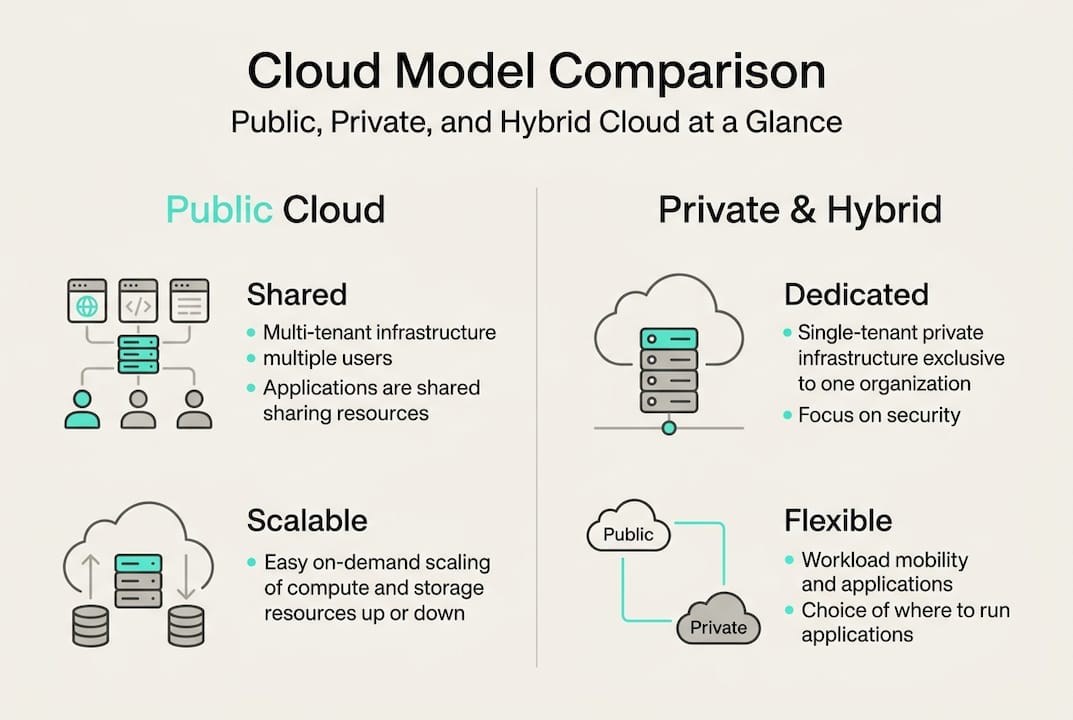
| Deployment model | Security control | Cost structure | Scalability | Compliance flexibility | Best suited for |
|---|---|---|---|---|---|
| Public cloud | Shared responsibility | Lowest operational cost | Highest elasticity | Standard frameworks | Innovation projects, variable workloads |
| Private cloud | Complete organizational control | Highest infrastructure investment | Limited by capacity | Maximum customization | Regulated data, legacy integration |
| Hybrid cloud | Balanced approach | Moderate combined cost | Flexible across environments | Selective placement | Mixed requirements, gradual migration |
UK enterprises must consider several factors when selecting deployment models:
- Data residency requirements ensuring information stays within UK jurisdiction
- Industry specific regulations like financial services compliance standards
- Integration needs with existing on premises systems and applications
- Skill availability for managing different infrastructure types
- Budget constraints balancing upfront investment against operational costs
- Risk tolerance regarding shared versus dedicated infrastructure
The right deployment model depends on your specific transformation goals, regulatory context, and operational constraints. Many UK organizations start with hybrid approaches, keeping core systems private while moving appropriate workloads to public cloud. This strategy provides transformation benefits while maintaining compliance and control where necessary.
Selecting deployment models represents a strategic decision affecting your transformation trajectory for years. Consider not just current requirements but future flexibility needs as your digital capabilities evolve and business models change.
Implementing cloud strategies for UK enterprises: practical steps and challenges
Successful cloud adoption requires clear strategy, stakeholder alignment, and strong governance rather than simply migrating systems. UK enterprises face unique considerations around data protection, regulatory compliance, and organizational change that demand thoughtful planning and execution.
Follow this structured approach for strategic cloud implementation:
- Assess your current state by inventorying applications, infrastructure dependencies, and business requirements across the organization
- Define transformation objectives linking cloud capabilities to specific business outcomes you want to achieve
- Develop a migration roadmap prioritizing applications based on business value, technical complexity, and risk factors
- Establish governance frameworks covering security policies, cost management, and compliance requirements before migration begins
- Execute phased migration starting with low risk applications to build experience and refine processes
- Optimize continuously by monitoring performance, controlling costs, and adjusting configurations based on actual usage patterns
- Measure results against defined objectives and communicate value to maintain stakeholder support throughout the journey
Common challenges threaten cloud adoption success if not addressed proactively. Legacy systems often lack documentation and contain hidden dependencies making migration risky. Skill gaps within IT teams slow implementation and increase reliance on external consultants. Security concerns from stakeholders unfamiliar with cloud models create resistance. Budget uncertainty around variable cloud costs makes financial planning difficult.
UK regulatory compliance adds complexity requiring careful attention. GDPR mandates strict data protection controls regardless of where systems operate. Financial services regulations impose specific requirements around data residency and access controls. Healthcare information governance demands particular security measures. Your cloud strategy must address these obligations explicitly through provider selection, configuration choices, and ongoing monitoring.
Practical considerations for UK enterprise cloud adoption:
- Choose providers with UK data center regions ensuring data residency compliance
- Implement identity and access management rigorously from the start
- Establish cost monitoring and alerting to prevent budget overruns
- Train teams continuously on cloud technologies and best practices
- Maintain hybrid capabilities supporting gradual migration timelines
- Document configurations and dependencies for audit and recovery purposes
- Build relationships with providers for support and strategic guidance
Getting stakeholder buy in requires demonstrating tangible business value beyond technical benefits. Present cloud adoption in terms of competitive advantage, revenue opportunities, and risk reduction rather than infrastructure efficiency. Show how cloud enables business initiatives currently blocked by technical constraints. Calculate ROI including both cost savings and value creation from new capabilities.
Pro Tip: Organizations that neglect change management and training during cloud migration experience significantly higher failure rates, so invest in preparing your people as much as your technology.
Measuring success goes beyond technical metrics to business outcomes. Track improvements in deployment speed, innovation velocity, and operational efficiency. Monitor cost trends ensuring spending aligns with usage and value. Assess security posture improvements through reduced incidents and faster threat response. Connect these measures to business results stakeholders care about.
Cloud transformation represents a journey rather than a destination. Your initial migration establishes foundation capabilities, but continuous optimization and expansion deliver ongoing value. Plan for evolution as your organization's digital maturity grows and new cloud capabilities emerge.
Explore tailored cloud solutions with Mighty Sky Technologies
Navigating cloud transformation complexity requires experienced partners who understand both technology and business strategy. Mighty Sky Technologies Limited brings deep expertise in cloud computing, digital transformation, and IT infrastructure management specifically tailored for UK enterprises. Our team helps organizations design cloud strategies aligned with business objectives, execute migrations minimizing risk, and optimize environments for ongoing value.
We recognize that every enterprise faces unique challenges around legacy systems, compliance requirements, and organizational readiness. Our consultative approach starts by understanding your transformation goals and constraints, then develops practical roadmaps balancing ambition with feasibility. Whether you need strategic planning, technical implementation, or ongoing optimization, we provide the expertise and support ensuring your cloud investment delivers measurable business results. Partner with us to accelerate your digital transformation journey while future proofing your technology investments.
FAQ
What is cloud computing in simple terms?
Cloud computing means accessing computing resources like servers, storage, and applications over the internet instead of owning and maintaining physical equipment. This model lets organizations use technology on demand, paying only for what they consume. The cloud provider handles infrastructure management while you focus on using capabilities to run your business.
How does cloud computing improve business agility?
Cloud platforms provide instant access to scalable resources and enable rapid deployment of new applications without lengthy procurement cycles. This flexibility lets businesses quickly respond to market opportunities, test innovations with minimal investment, and adjust capacity based on actual demand. Organizations can launch initiatives in days rather than months, gaining competitive advantage through speed.
What are the main types of cloud deployment models?
Public cloud uses shared infrastructure accessible over the internet, offering maximum scalability and lowest costs. Private cloud provides dedicated infrastructure for one organization, delivering greater control and customization for sensitive workloads. Hybrid cloud combines both models, letting organizations place workloads strategically based on security, compliance, and performance requirements while maintaining flexibility.
Why do UK enterprises choose hybrid cloud approaches?
Hybrid cloud lets UK organizations balance regulatory compliance requirements with transformation benefits. Sensitive data and regulated workloads remain in private infrastructure meeting data residency and control obligations, while other applications leverage public cloud scalability and innovation capabilities. This approach provides flexibility for gradual migration while maintaining compliance throughout the journey.
What skills do teams need for successful cloud adoption?
Cloud adoption requires both technical skills in platform management, security configuration, and automation, plus strategic capabilities around architecture design, cost optimization, and governance. Teams need understanding of cloud service models, networking concepts, and identity management. Equally important are change management abilities to guide organizational transformation and business acumen connecting technology choices to outcomes.