
UK enterprises often confuse digital workplaces with simple cloud storage or video conferencing platforms. This narrow view misses the transformative potential of a fully integrated digital environment that fundamentally reshapes how teams collaborate, communicate, and deliver results. A true digital workplace combines communication tools, security frameworks, analytics platforms, and cloud infrastructure into a unified ecosystem that drives measurable productivity gains and competitive advantage. This guide unpacks the core components, quantifiable benefits, implementation challenges, and strategic approaches that UK IT managers need to optimize their digital workplace investments and achieve sustainable operational excellence.
Table of Contents
- Key takeaways
- Defining the digital workplace: core components and technologies
- Measuring impact: productivity, collaboration, and ROI in UK enterprises
- Challenges and nuances: avoiding common pitfalls in digital workplace adoption
- Strategic approaches for UK IT managers: optimizing digital workplace success
- Discover tailored digital workplace solutions with Mighty Sky Technologies
- Frequently asked questions
Key Takeaways
| Point | Details |
|---|---|
| Integrated ecosystem | A true digital workplace integrates communication, security, analytics, and cloud infrastructure into a single ecosystem that improves collaboration and productivity. |
| Productivity gains | Well governed digital workplaces deliver productivity gains around 20 to 25 percent and boost remote work efficiency. |
| UK case studies | UK NHS Trusts reported 90 percent SLA improvements, 400 percent adoption growth, and about one million pounds ROI within 18 months of deployment. |
| Adoption challenges | Tool sprawl, digital friction, and cybersecurity risks require integrated governance and a focus on user experience. |
| Platform integration | Prioritize platforms with native integrations and open APIs to minimize fragmentation and support a seamless employee experience. |
Defining the digital workplace: core components and technologies
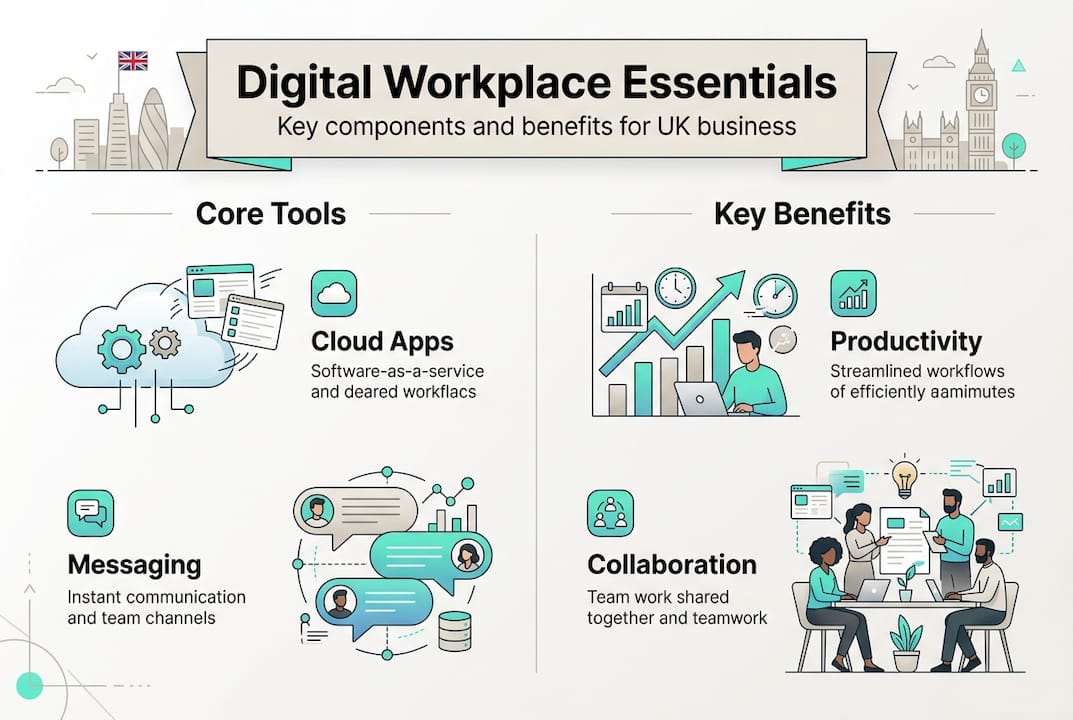
A digital workplace is a virtualized environment combining digital applications, cloud computing, collaboration tools, security, storage, analytics, and management to enable productivity, communication, and collaboration regardless of location. This definition emphasizes integration rather than isolated tools. Your organization might use Microsoft Teams, Slack, or Google Workspace, but without proper integration, these become silos that fragment workflows and reduce efficiency.
The core components work together as an ecosystem:
| Component | Function | Example Technologies |
|---|---|---|
| Communication | Real-time messaging, video conferencing, email integration | Microsoft Teams, Slack, Zoom |
| Security | Identity management, access control, threat detection | Azure AD, Okta, CrowdStrike |
| Storage | Cloud-based file systems, version control, backup | OneDrive, SharePoint, Box |
| Analytics | Usage tracking, performance metrics, employee insights | Power BI, Tableau, Workplace Analytics |
| Management | Device management, application deployment, policy enforcement | Intune, Jamf, VMware Workspace ONE |
Cloud infrastructure forms the foundation of modern digital workplaces. It enables remote access, scales resources dynamically, and reduces capital expenditure on physical infrastructure. Collaboration tools built on cloud platforms allow teams to work synchronously or asynchronously across time zones and locations. This flexibility proved essential during the shift to hybrid work models that now define UK enterprise operations.
Mighty Sky Technologies Limited specializes in building these integrated environments for UK enterprises, ensuring seamless interoperability between components. The goal is creating a unified experience where employees access everything through a single interface rather than juggling multiple disconnected applications.
Pro Tip: Prioritize platforms with native integrations and open APIs to avoid fragmentation. Evaluate how well key features every SaaS needs align with your existing technology stack before committing to new solutions.
Measuring impact: productivity, collaboration, and ROI in UK enterprises
Digital tools boost productivity 20-25%, remote workers are 13% more productive, collaboration satisfaction increases 40%, and the market is projected to reach $107 billion by 2028. These statistics represent real operational improvements that translate directly to bottom-line results. UK enterprises implementing comprehensive digital workplace strategies consistently report measurable gains across multiple dimensions.

| Metric | Improvement | Time Frame |
|---|---|---|
| Employee Productivity | 20-25% increase | 6-12 months |
| Remote Work Efficiency | 13% higher output | 3-6 months |
| Collaboration Satisfaction | 40% improvement | 6-9 months |
| Platform Adoption Rate | 85-95% active users | 12-18 months |
UK-specific case studies demonstrate exceptional returns. NHS Trusts achieved 90% SLA improvement, 400% adoption increase, and £1 million ROI within 18 months of deploying integrated digital workplace solutions. British Airways experienced a 30-point engagement rise and 91% usage rate across their workforce. These results stem from strategic implementation focused on user experience and comprehensive change management.
Measurable benefits IT managers can expect include:
- Reduced time spent searching for information and coordinating across teams
- Faster decision-making through improved access to data and analytics
- Lower operational costs from reduced travel and physical infrastructure needs
- Enhanced employee retention through improved work-life balance and flexibility
- Stronger security posture through centralized identity management and monitoring
"The digital workplace market's explosive growth to $107 billion by 2028 reflects fundamental shifts in how organizations operate. Remote workers consistently outperform office-based peers by 13%, while collaboration satisfaction jumps 40% with proper digital tools. These aren't marginal gains but transformative improvements that redefine competitive advantage."
Mighty Sky case studies and ROI documentation provides detailed breakdowns of implementation timelines, investment requirements, and expected returns for UK enterprises across various sectors. The key to achieving these results lies in comprehensive planning, phased rollouts, and continuous optimization based on usage analytics.
Challenges and nuances: avoiding common pitfalls in digital workplace adoption
Challenges include autonomy paradox, digital friction, tool sprawl, poor governance, and cybersecurity risks with 95% of breaches linked to human error. The autonomy paradox describes how increased flexibility and control over work schedules can paradoxically lead to longer working hours, blurred boundaries between work and personal life, and distorted time perception. Employees feel simultaneously empowered and overwhelmed by constant connectivity.
Digital friction emerges when poorly integrated tools create unnecessary steps, duplicate data entry, or force context switching between applications. This friction accumulates across daily workflows, eroding the productivity gains that digital workplaces promise. Research shows employees spend significant time navigating between systems rather than focusing on core tasks.
Common pitfalls that undermine digital workplace success:
- Tool sprawl from uncoordinated departmental purchases creating fragmented ecosystems
- Insufficient governance frameworks allowing shadow IT and security vulnerabilities
- Inadequate training leaving employees unable to leverage advanced features
- Poor change management resulting in low adoption rates and resistance
- Neglecting mobile experience despite increasing smartphone-based work
- Overlooking accessibility requirements that exclude portions of the workforce
Cybersecurity vulnerabilities represent the most serious risk. Human error causes 95% of security breaches, emphasizing the critical need for comprehensive training programs that go beyond annual compliance modules. Phishing attacks, weak passwords, and unauthorized data sharing remain persistent threats that sophisticated technical controls alone cannot eliminate.
"Employees waste an average of 2.5 hours daily chasing information across disconnected systems. This 'info chasing' time represents pure productivity loss that compounds across organizations, costing UK enterprises billions annually in lost output and employee frustration."
Pro Tip: Implement strong governance frameworks that balance employee autonomy with organizational control. Establish clear policies for tool approval, data handling, and access management. Invest in building digital dexterity through ongoing training that evolves with your technology stack. Mighty Sky Technologies Limited offers governance consulting that helps UK enterprises establish sustainable frameworks without stifling innovation.
Strategic approaches for UK IT managers: optimizing digital workplace success
Prioritize integrated platforms with strong governance and employee-centric design to overcome sprawl and friction. Successful digital workplace implementations follow deliberate strategies that address technical, organizational, and human factors simultaneously. UK IT managers should adopt a systematic approach that balances immediate needs with long-term scalability.
Strategic steps for successful digital workplace adoption:
- Conduct comprehensive needs assessment involving stakeholders across departments and levels
- Establish governance committee with representation from IT, HR, security, and business units
- Select integrated platform ecosystem rather than best-of-breed point solutions
- Design phased rollout starting with pilot groups and expanding based on feedback
- Develop comprehensive training program with role-specific content and ongoing support
- Implement analytics framework to track adoption, usage patterns, and friction points
- Create feedback loops enabling continuous improvement based on employee experience data
- Plan for regular technology refresh cycles to maintain currency and security
| Approach | Integrated Platform | Tool Sprawl |
|---|---|---|
| Governance | Centralized policies, single vendor accountability | Fragmented policies, multiple vendor negotiations |
| User Experience | Consistent interface, seamless workflows | Context switching, duplicate logins |
| Security | Unified identity management, comprehensive monitoring | Multiple attack surfaces, inconsistent controls |
| Cost Structure | Predictable licensing, volume discounts | Hidden costs, license overlap |
| Support Model | Single support channel, integrated troubleshooting | Multiple support contacts, finger-pointing |
Focus on scalable cloud solutions tailored for hybrid work models. Your platform must support seamless transitions between office, home, and mobile contexts without degrading functionality or security. Employees should experience identical capabilities regardless of location or device. This consistency reduces cognitive load and enables true flexibility.
Building digital dexterity requires more than initial training. Establish ongoing learning programs that introduce advanced features progressively, celebrate power users who can mentor peers, and provide just-in-time support through embedded help and chatbots. Analytics reveal which features remain underutilized and where additional training delivers the highest return.
Pro Tip: Implement iterative employee feedback mechanisms and use analytics to detect friction points before they impact productivity. Monthly pulse surveys, usage heatmaps, and support ticket analysis reveal emerging issues that quantitative metrics alone might miss. Mighty Sky platform solutions include built-in analytics dashboards that surface actionable insights for continuous optimization.
Discover tailored digital workplace solutions with Mighty Sky Technologies
Transforming your digital workplace from fragmented tools into an integrated productivity engine requires expertise, planning, and ongoing support. Mighty Sky Technologies Limited partners with UK enterprises to design, implement, and optimize comprehensive digital workplace solutions that deliver measurable results. Our approach combines technical excellence with deep understanding of organizational change dynamics.
We offer expert consultancy that assesses your current state, identifies gaps and opportunities, and develops roadmaps aligned with your business objectives. Our tailored cloud platforms integrate communication, security, storage, and analytics into unified environments that employees actually want to use. Ongoing support ensures your digital workplace evolves with changing needs and emerging technologies.
Our services include platform integration that connects existing investments with new capabilities, governance frameworks that balance control with flexibility, and employee training programs that build lasting digital dexterity across your organization. We measure success through your productivity gains, adoption rates, and employee satisfaction scores.
Frequently asked questions
What is a digital workplace?
A digital workplace is a virtual work environment integrating communication tools, cloud storage, security frameworks, analytics platforms, and management systems into a unified ecosystem. It enables employees to work productively from any location using any device while maintaining security and collaboration capabilities. Unlike traditional office setups, digital workplaces prioritize flexibility, accessibility, and data-driven optimization of workflows and employee experience.
How does a digital workplace differ from a traditional intranet?
Traditional intranets function primarily as information repositories with limited interaction capabilities and static content. Digital workplaces provide dynamic, interactive environments where employees communicate in real time, collaborate on documents simultaneously, and access personalized dashboards with relevant tools and data. The shift represents moving from passive information consumption to active participation in integrated workflows that span communication, collaboration, and task management within a single platform.
What role does AI play in digital workplaces?
AI enhances digital workplaces through intelligent search that understands context and intent, automated workflow routing that reduces manual tasks, and predictive analytics that surface insights from usage patterns. Chatbots provide instant support for common questions, while machine learning algorithms optimize meeting scheduling and resource allocation. However, AI augments rather than replaces human judgment, requiring oversight to prevent bias and ensure alignment with organizational values and employee needs.
How can UK enterprises measure digital workplace success?
Track productivity improvements through output metrics and time-to-completion data, monitor adoption rates via active user counts and feature utilization statistics, and assess collaboration effectiveness using communication frequency and project velocity measures. Employee engagement scores from regular surveys reveal satisfaction and identify friction points. Compare service level agreement performance and operational costs before and after implementation to quantify ROI. Comprehensive dashboards combining these metrics provide holistic views of digital workplace impact.
What are the main security risks in digital workplaces?
Human error causes 95% of security breaches, making employee training the most critical security investment. Common vulnerabilities include phishing attacks exploiting trust, weak passwords enabling unauthorized access, and accidental data sharing through misconfigured permissions. Tool sprawl creates multiple attack surfaces that are difficult to monitor comprehensively. Poor governance allows shadow IT deployments that bypass security controls. Addressing these risks requires combining technical controls with ongoing security awareness programs and clear policies.
How can UK enterprises measure the ROI of digital workplace investments?
Track productivity improvements by comparing output metrics and project completion times before and after implementation. Monitor adoption rates through active user statistics and feature utilization data to ensure investments deliver actual usage. Measure collaboration metrics including communication frequency, document co-authoring instances, and cross-functional project velocity. Survey employee engagement scores to quantify satisfaction improvements. Compare service level agreement performance and operational cost reductions, particularly in areas like travel, physical infrastructure, and support tickets, to calculate comprehensive financial returns.