
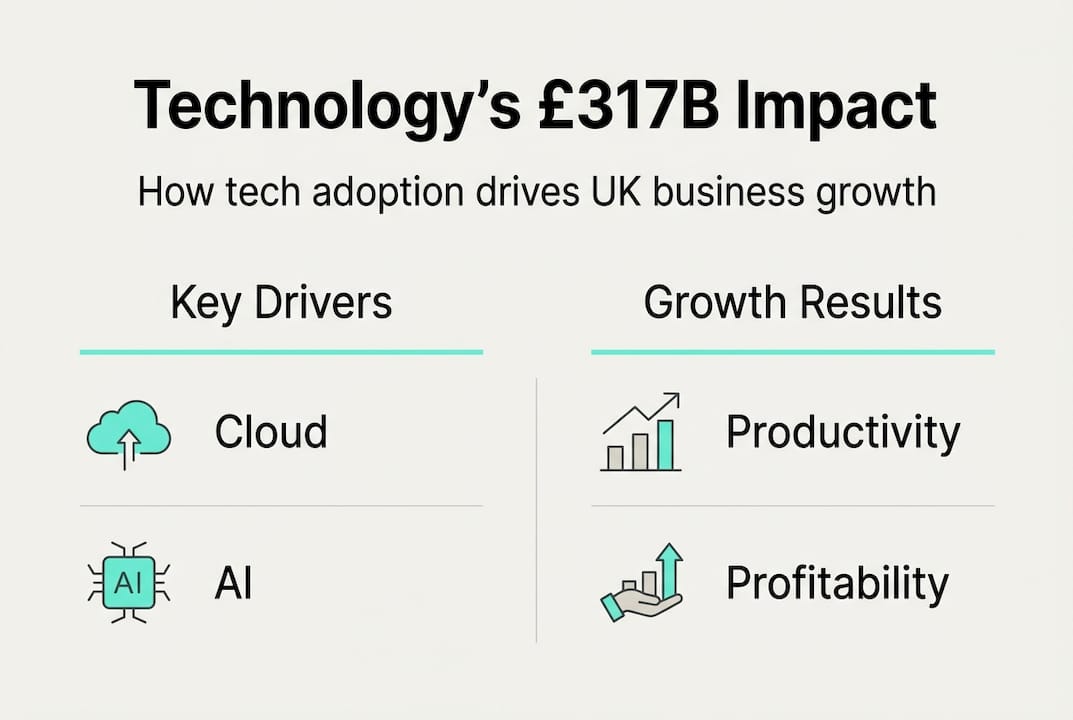
Emerging technologies could add £317 billion to UK GDP and raise productivity by nearly 12 percent, yet many UK business leaders still treat technology as a line-item cost rather than a growth engine. That gap between perception and reality is costing companies real competitive ground. This article cuts through the noise to clarify what technology actually does for your business, which tools deliver the biggest returns, and how to build a practical roadmap that turns investment into measurable results. Whether you lead a startup or a large enterprise, the frameworks here will help you move from confusion to confident action.
Table of Contents
- Technology as a strategic business growth engine
- Key technologies transforming UK businesses
- Building a digital transformation strategy: Roadmap and methodologies
- Overcoming barriers: Skills, legacy systems, and cultural change
- Maximizing ROI: Budgeting, measuring impact, and leveraging resources
- Partnering for technology-led growth
- Frequently asked questions
Key Takeaways
| Point | Details |
|---|---|
| Tech boosts productivity | Technology adoption can drive nearly 12 percent GDP growth for UK businesses. |
| Strategic roadmap matters | A phased digital transformation approach maximizes ROI and reduces risk. |
| Overcome cultural barriers | Invest in data cleansing and leadership buy-in to lift resistance and legacy obstacles. |
| Measure impact smartly | Using FinOps and metrics helps track real returns and guides investment decisions. |
| Leverage UK support | Government programs like Made Smarter offer tailored advice and resource access for tech-led growth. |
Technology as a strategic business growth engine
Technology stopped being just an operational tool a long time ago. Today it is a strategic asset that shapes how you compete, how fast you scale, and how much value you create for customers. The distinction matters because leaders who treat tech as overhead tend to underinvest at exactly the wrong moment, while those who treat it as a growth multiplier consistently outpace their peers.
The evidence is clear. Technology drives growth through productivity gains and entirely new consumption channels, but only when firms define clear use cases and scale AI deliberately. That last part is critical. Buying software without a use case is like buying a factory without a production plan.
"The businesses that win with technology are not the ones that spend the most. They are the ones that align every technology decision with a specific business outcome."
Here is what strategic technology adoption actually delivers for UK businesses:
- Productivity gains through automation of repetitive tasks, freeing your team for higher-value work
- Competitive advantage via AI-driven insights that surface opportunities your competitors miss
- New revenue channels enabled by cloud platforms and digital marketplaces
- Faster decision-making through real-time business intelligence dashboards
- Scalability without proportional increases in headcount or infrastructure cost
Understanding the digital transformation benefits for your specific sector is the starting point. Once you connect technology to a tangible business outcome, the investment case becomes straightforward.
Key technologies transforming UK businesses
Not all technologies deliver equal value, and not every tool fits every business. Knowing which technologies are moving the needle right now helps you prioritize budget and effort. AI, cloud, and BI adoption measurably boosts productivity among UK SMEs, which represent 99 percent of all UK businesses and account for 60 percent of employment.
The six technologies with the highest current impact for UK businesses:
- Artificial intelligence (AI): Automates analysis, personalizes customer experiences, and accelerates product development cycles
- Cloud computing: Reduces infrastructure costs, enables remote collaboration, and supports rapid scaling
- Business intelligence (BI): Converts raw data into actionable insights for faster, smarter decisions
- Computer-aided design (CAD): Cuts product development time and reduces prototyping costs in manufacturing and engineering
- Virtual and augmented reality (VR/AR): Transforms training, customer demos, and remote technical support
- Internet of Things (IoT): Connects physical assets to digital systems, enabling predictive maintenance and real-time monitoring
Here is a direct comparison of how these technologies stack up across three critical business dimensions:
| Technology | Operational efficiency | Customer experience | Scalability |
|---|---|---|---|
| AI | Very high | Very high | High |
| Cloud computing | High | Medium | Very high |
| Business intelligence | High | High | Medium |
| CAD | High | Low | Medium |
| VR/AR | Medium | High | Low |
| IoT | Very high | Medium | High |
For most UK SMEs, cloud computing and AI offer the fastest path to measurable returns because they require relatively low upfront capital and deliver results within months rather than years. Building a strong digital workplace around these tools also reduces operational friction significantly. And as you scale, cybersecurity for business becomes non-negotiable because every new connected system is also a potential vulnerability.

Stat to know: SMEs that adopt at least three of these technologies report productivity gains that compound over time, with the strongest results appearing in year two and beyond.
Building a digital transformation strategy: Roadmap and methodologies
Knowing which technologies matter is only half the battle. The other half is executing a transformation that actually sticks. Most failed transformations do not fail because of bad technology. They fail because of poor planning, unclear ownership, and no mechanism to measure progress.
A proven five-stage digital roadmap covers assessment, planning, piloting, scaling, and optimizing, and includes consumption metering to keep costs visible throughout. Here is how each stage works in practice:
- Foundation: Audit your current systems, data quality, and team capabilities. Identify gaps and establish a baseline for measuring future progress.
- Strategy: Define specific business outcomes you want technology to deliver. Assign ownership and set a realistic budget with phased milestones.
- Pilot: Launch a small, contained project in one department or process. Measure results rigorously before committing to wider rollout.
- Scale: Expand what works. Use consumption metering (tracking actual usage versus projected usage) to control costs and justify further investment.
- Sustain: Build continuous improvement into your operating model. Review technology performance quarterly and retire tools that no longer deliver value.
Pro Tip: Start your pilot in a department where the team is already curious about technology. Early adopters generate internal case studies that make scaling far easier because skeptical colleagues respond to peer evidence, not vendor promises.
Aligning your business strategy with your technology strategy is where most leaders struggle. A useful framework is to map every technology initiative to one of three outcomes: reduce cost, increase revenue, or improve customer experience. If a project cannot be mapped to at least one of these, it should not be funded. Learning how to upgrade business technology systematically prevents the common trap of accumulating disconnected tools that create more complexity than they solve. For leaders exploring cloud computing for transformation, the cloud is often the most practical foundation to build the rest of your stack on.
| Stage | Key action | Success metric |
|---|---|---|
| Foundation | Systems and data audit | Baseline report complete |
| Strategy | Outcome mapping | Approved roadmap with budget |
| Pilot | Contained deployment | ROI measured within 90 days |
| Scale | Phased rollout | Cost per unit reduced |
| Sustain | Quarterly review | Continuous improvement logged |
Overcoming barriers: Skills, legacy systems, and cultural change
Even the best roadmap hits friction. The three most common barriers for UK businesses are outdated legacy systems, skills shortages, and cultural resistance to change. Each one is solvable, but only if you address it directly rather than hoping it resolves itself.
Legacy systems are often the most expensive problem because they create data silos, slow down integrations, and require specialist maintenance that is increasingly hard to source. The fix is rarely a full replacement overnight. A phased migration, starting with the systems that touch the most business processes, is usually the most practical path.
SMEs face greater risk from legacy systems, skills shortages, and cultural barriers, and success consistently requires data cleanup before any new system goes live, plus visible leadership buy-in from day one. That second point is often underestimated. When the leadership team visibly champions a transformation, adoption rates across the organization improve dramatically.
Here are the most effective actions for overcoming each barrier:
- Legacy systems: Prioritize data cleansing before migration. Dirty data in a new system creates the same problems as dirty data in an old one.
- Skills gaps: Use UK programs like Made Smarter to access subsidized training and specialist guidance. Remote IT support can also bridge capability gaps while you build internal expertise.
- Cultural resistance: Involve frontline staff in the pilot stage. People support what they help build. Communicate the "why" clearly and repeatedly.
- Budget constraints: Start with free or low-cost tiers of cloud and AI tools to demonstrate value before committing to enterprise contracts.
Pro Tip: Secure a named executive sponsor for every transformation initiative. Projects with a visible C-suite champion are significantly more likely to reach the scale stage than those managed purely at the operational level.
Maximizing ROI: Budgeting, measuring impact, and leveraging resources
Getting the most from your technology investment requires discipline in three areas: how you budget, how you measure, and which external resources you tap. Most businesses do one of these well. The ones that do all three consistently outperform.
Here is a practical sequence for maximizing ROI:
- Phase your budget: Allocate initial spend to pilot projects with a 90-day measurement window. Only scale what demonstrates clear returns.
- Implement FinOps: FinOps (financial operations for cloud) is a practice that gives finance, engineering, and business teams shared visibility into technology spending. It prevents the common problem of cloud costs growing faster than the value they generate.
- Track the right metrics: Revenue per employee, cost per transaction, and customer acquisition cost are more useful than vanity metrics like number of tools deployed.
- Tap government support: The UK offers several programs to reduce the cost and risk of technology adoption. UK tech business support programs provide funding, mentoring, and connections to specialist advisors.
- Review and reallocate: Set a quarterly cadence to review technology performance. Reallocate budget from underperforming tools to those delivering measurable results.
The long-term financial case for technology investment is compelling. Increasing data maturity can boost earnings per share by 35 to 46 percent over five years for firms comparable to S&P 500 companies. That is not a marginal gain. It is a structural competitive advantage built through consistent, disciplined investment in the right tools and practices.
Strong IT infrastructure underpins all of this. Without a reliable, secure foundation, even the best technology strategy will underdeliver. And optimizing business technology on an ongoing basis, rather than treating it as a one-time project, is what separates businesses that sustain growth from those that plateau after an initial burst of improvement.
Partnering for technology-led growth
The frameworks in this article give you a clear path from strategy to execution. But knowing the roadmap and navigating it successfully are two different things. Most UK business leaders who achieve consistent technology-led growth do so with a trusted partner who understands both the technology landscape and the specific pressures of running a UK business.
At Mightyskytech.com, we work with UK businesses across every stage of the transformation journey, from initial infrastructure audits and cloud migrations to ongoing managed IT support and cybersecurity. Our approach is always tailored to your specific business outcomes, not a generic package. If you are ready to turn your technology investment into a measurable growth driver, we would welcome a conversation about where to start and how to build momentum that lasts.
Frequently asked questions
What are the top technologies driving UK business growth?
AI, cloud, BI, CAD, VR/AR, and IoT are currently the most impactful technologies for UK businesses, with AI and cloud delivering the fastest returns for most SMEs. Each technology addresses a different operational challenge, so the right mix depends on your specific business model.
How can business leaders overcome resistance to technology change?
Overcoming resistance requires data cleansing first, clear leadership buy-in, and involving frontline staff early in the pilot stage. Programs like Made Smarter also provide structured support for skills development and change management.
What practical steps help maximize ROI on technology investments?
Implement phased pilots with 90-day measurement windows, track ROI using FinOps practices, and use UK government programs like Help to Grow or Made Smarter for subsidized support and specialist guidance.
How does data maturity impact business profitability?
Increasing data maturity can raise earnings per share by up to 46 percent over five years, based on research modeled on S&P 500-comparable firms. Businesses that invest in data quality and governance consistently outperform those that do not.