
Most UK businesses now rely on remote IT support to maintain operations, yet many underestimate its strategic value beyond simple troubleshooting. Remote IT support enables technicians to diagnose and resolve issues without physical presence, cutting resolution times dramatically. For businesses navigating hybrid work models and escalating cyber threats, understanding how remote support operates and integrates with broader digital strategies is essential. This guide clarifies what remote IT support truly entails, how it strengthens efficiency and cybersecurity, and why a hybrid approach often delivers optimal results for UK organizations pursuing digital transformation in 2026.
Table of Contents
- Understanding Remote IT Support: Definition And Core Processes
- How Remote IT Support Boosts Efficiency And Safeguards Cybersecurity In UK Businesses
- Navigating The Hybrid Model: Balancing Remote And On-Site IT Support
- Implementing Remote IT Support For Digital Transformation In UK Businesses
- How Mighty Sky Technologies Can Support Your Remote IT Needs
- Frequently Asked Questions About Remote IT Support
Key takeaways
| Point | Details |
|---|---|
| Remote IT support definition | Technicians access systems securely over networks to troubleshoot, patch, and maintain infrastructure without on-site visits. |
| Efficiency and cost benefits | Eliminates travel time and expenses, reduces mean time to repair, and enables 24/7 support coverage for distributed teams. |
| Cybersecurity enhancement | Encrypted connections, multi-factor authentication, and audit logs strengthen security posture and compliance with UK standards. |
| Hybrid model necessity | Hardware failures and physical installations require on-site visits, making combined remote and on-site strategies most effective. |
| Digital transformation enabler | Remote support facilitates cloud migration, hybrid workforce management, and scalable IT infrastructure for growing businesses. |
Understanding remote IT support: definition and core processes
Remote IT support involves technicians using secure network connections to access client systems, diagnose problems, and implement fixes without traveling to physical locations. Tools like TeamViewer and AnyDesk establish encrypted sessions between support staff and endpoint devices, allowing real-time screen sharing, file transfers, and system configuration changes. This approach transforms traditional break-fix models into proactive, always-available assistance that aligns with modern business demands.
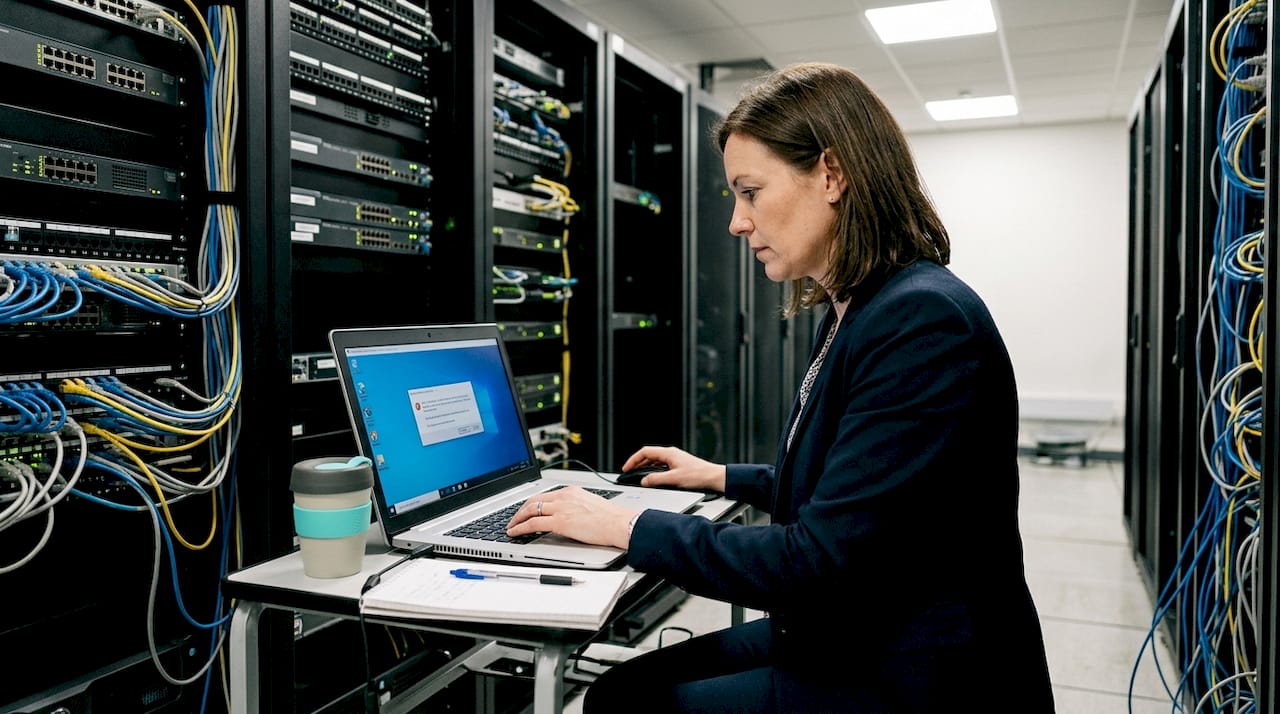
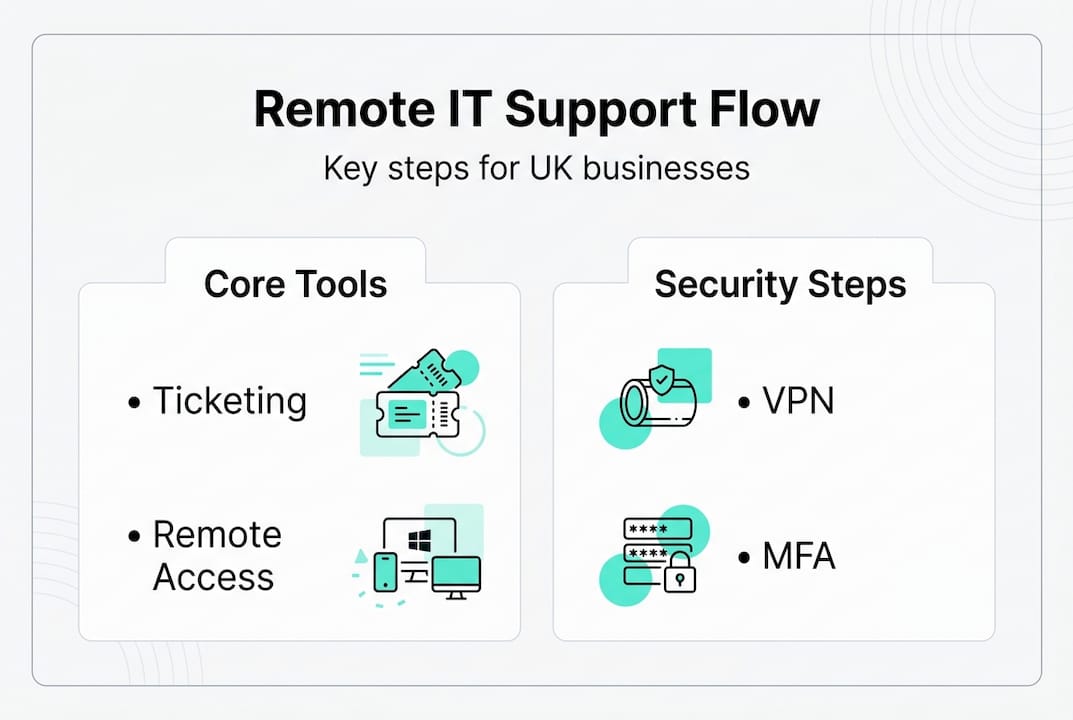
The typical workflow begins when users submit tickets through helpdesk portals or email systems. Support teams triage requests based on urgency and complexity, then initiate remote sessions with affected devices. Technicians authenticate using role-based access controls, ensuring only authorized personnel handle sensitive systems. Session recordings and activity logs create audit trails for compliance and quality assurance. Once resolved, tickets close with documentation detailing root causes and corrective actions, building knowledge bases that speed future resolutions.
Remote monitoring and management (RMM) platforms elevate this reactive model to proactive oversight. These tools continuously scan networks for performance anomalies, security vulnerabilities, and capacity constraints. Eighty-five percent of managed service providers now deploy compliant solutions like TeamViewer Tensor and NinjaOne to support clients remotely, automating patch deployment, backup verification, and threat detection. Alerts trigger before users notice problems, preventing downtime that disrupts operations.
Security protocols underpin every remote session. Virtual private networks (VPNs) encrypt data in transit, while multi-factor authentication (MFA) verifies technician identities beyond simple passwords. UK businesses subject to GDPR must ensure remote access tools maintain data sovereignty and provide granular permission controls. Mighty Sky Technologies Limited implements these safeguards as standard practice, recognizing that trust depends on transparent, auditable security measures.
Pro Tip: Require remote support vendors to demonstrate their incident response procedures and show recent penetration test results before granting network access.
The combination of ticketing systems, remote access tools, and RMM platforms creates a comprehensive support ecosystem. This infrastructure handles everything from password resets to complex server migrations, delivering consistent service regardless of user location. For UK businesses with distributed teams or multiple office locations, this consistency proves invaluable. Remote support eliminates geographic barriers, ensuring London headquarters and Manchester branch offices receive identical response quality.
How remote IT support boosts efficiency and safeguards cybersecurity in UK businesses
Eliminating physical travel transforms support economics and timelines. On-site visits consume hours in transit, limiting daily ticket volumes and inflating labor costs. Remote sessions launch within minutes, allowing technicians to address multiple issues across different locations in the time a single site visit would require. NHS NW London reported eighty percent time savings after implementing remote support, reallocating those hours to strategic projects rather than routine maintenance.
Cost reductions extend beyond labor efficiency. Businesses avoid mileage reimbursements, vehicle maintenance, and travel insurance premiums associated with field technicians. Remote-first strategies also reduce real estate needs, as support staff work effectively from centralized hubs or home offices. For small and medium enterprises (SMEs) operating on tight margins, these savings directly improve profitability while maintaining service quality.
Round-the-clock availability becomes feasible with remote support models. Providers can staff follow-the-sun operations, routing tickets to technicians in optimal time zones without requiring local offices in every region. UK businesses benefit from overnight monitoring and maintenance windows that minimize disruption to daytime operations. Critical systems receive continuous oversight, catching issues before they escalate into outages that halt revenue-generating activities.
Cybersecurity strengthens through multiple mechanisms built into remote support infrastructure:
- Encrypted remote access prevents credential interception and man-in-the-middle attacks during support sessions
- Multi-factor authentication adds verification layers that thwart compromised password exploitation
- Session recording creates forensic evidence for security investigations and compliance audits
- Automated patch management closes vulnerabilities faster than manual deployment cycles
- Centralized logging detects anomalous access patterns indicating potential breaches
These protections address urgent threats facing UK organizations. Forty-three percent of UK businesses experienced security breaches in recent surveys, with phishing and ransomware causing substantial financial and reputational damage. Remote support enables rapid deployment of security updates and configuration hardening across entire networks simultaneously, rather than scheduling individual on-site visits that leave systems exposed during delays.
"Remote IT support transforms cybersecurity from reactive firefighting to proactive defense, enabling businesses to implement controls before threats materialize rather than scrambling after incidents occur."
Compliance frameworks like Cyber Essentials require specific technical controls including VPN usage, MFA implementation, and regular patching schedules. Remote support infrastructure naturally aligns with these requirements, simplifying certification processes. Providers familiar with UK regulations guide clients through evidence gathering and control validation, reducing compliance burden while strengthening actual security posture.
The efficiency and security benefits compound over time. Faster resolutions mean less productivity loss per incident. Better security reduces breach frequency and associated recovery costs. Together, these advantages create measurable ROI that justifies remote support investments even for budget-conscious organizations.
Navigating the hybrid model: balancing remote and on-site IT support
Remote support excels at software troubleshooting, configuration changes, and system monitoring, but physical hardware issues expose its limitations. Eighty to ninety percent of IT issues resolve remotely, yet the remaining fraction demands hands-on intervention. Failed hard drives require physical replacement. Network switches need cable reconnections. New equipment installations involve unpacking, mounting, and initial configuration that remote sessions cannot accomplish.
Air-gapped systems present another constraint. High-security environments deliberately isolate critical infrastructure from network connections, preventing remote access by design. Financial institutions, government agencies, and healthcare providers often maintain such systems to protect sensitive data. These scenarios necessitate on-site technicians with appropriate clearances and physical access permissions.
Hybrid models combine both approaches strategically. Routine maintenance, software updates, and user support happen remotely, maximizing efficiency. Hardware deployments, physical security implementations, and specialized troubleshooting trigger on-site dispatches. This division optimizes resource allocation, sending expensive field technicians only when truly necessary while handling the majority of work remotely.
Pro Tip: Establish clear escalation criteria defining when issues transition from remote to on-site handling, preventing wasted time on problems that require physical presence.
The comparison below illustrates optimal use cases:
| Scenario | Remote Support | On-Site Support | | --- | --- | | Password resets and account unlocks | Ideal for immediate resolution | Unnecessary travel expense | | Software installation and configuration | Efficient remote deployment | Only if network access unavailable | | Server hardware failure | Diagnosis possible remotely | Physical component replacement required | | Network infrastructure installation | Planning and configuration remotely | Physical cabling and equipment mounting | | Security camera setup | Software configuration remotely | Physical installation and positioning | | Printer troubleshooting | Driver and settings adjustments remotely | Paper jams and mechanical repairs on-site |
Regional UK IT providers increasingly recommend hybrid approaches to ensure business resilience. Birmingham and Manchester MSPs report higher client satisfaction when combining remote efficiency with on-site availability for urgent hardware needs. This flexibility proves especially valuable for manufacturing, retail, and hospitality sectors where physical equipment failures directly impact customer-facing operations.
Hybrid strategies also address user preferences and comfort levels. Some employees feel more confident with in-person support for complex issues, valuing face-to-face explanation and reassurance. Others prefer the speed and convenience of remote assistance that doesn't disrupt their workspace. Offering both options accommodates diverse working styles while maintaining consistent service standards.
The hybrid approach extends to disaster recovery planning. Remote backup monitoring and cloud failover happen automatically, but physical site damage from fires or floods requires on-site assessment and hardware replacement. Mighty Sky Technologies Limited coordinates both remote and physical recovery activities, ensuring comprehensive business continuity regardless of incident type.
Implementing remote IT support for digital transformation in UK businesses
Remote IT support serves as foundational infrastructure for digital transformation initiatives reshaping UK workplaces. Forty percent of UK workers now operate in remote or hybrid arrangements by 2026, requiring IT support that reaches beyond traditional office boundaries. Organizations cannot effectively support distributed teams without robust remote capabilities that deliver consistent service regardless of employee location.
Cloud migration depends heavily on remote support expertise. Moving applications and data from on-premises servers to cloud platforms involves complex configuration, security implementation, and performance optimization. Remote technicians manage these transitions without disrupting operations, conducting migrations during off-peak hours and providing immediate rollback capabilities if issues arise. This approach minimizes risk while accelerating cloud adoption timelines.
Scalability becomes straightforward with remote support infrastructure. Adding new users or locations requires only network connectivity and endpoint provisioning, not physical office buildouts or local IT staff hiring. Businesses expanding into new UK regions or international markets extend support coverage instantly, avoiding the delays and expenses of establishing local IT presence.
UK businesses can implement remote IT support through these steps:
- Assess current IT infrastructure to identify systems requiring remote access capabilities and security gaps needing remediation before implementation.
- Select compliant remote access tools meeting GDPR requirements, ensuring data sovereignty and audit logging capabilities aligned with UK regulations.
- Establish security policies defining authentication requirements, session monitoring procedures, and access control rules for different user and technician roles.
- Train staff on ticket submission processes, remote session protocols, and security best practices to maximize efficiency and minimize resistance.
- Deploy RMM platforms for proactive monitoring, automating routine maintenance tasks and alerting technicians to emerging issues before users report problems.
- Document standard operating procedures covering common scenarios, building knowledge bases that speed resolutions and enable consistent service quality.
- Review service level agreements (SLAs) with providers, confirming response times, escalation paths, and performance metrics align with business requirements.
Digital transformation metrics demonstrate remote support impact:
| Metric | Before Remote Support | After Implementation | Improvement |
|---|---|---|---|
| Mean time to repair (MTTR) | 4.2 hours | 0.8 hours | 81% reduction |
| Support cost per ticket | £45 | £12 | 73% savings |
| First-call resolution rate | 62% | 89% | 27 percentage points |
| User satisfaction score | 3.2/5.0 | 4.6/5.0 | 44% increase |
These improvements enable businesses to pursue strategic initiatives rather than constantly addressing IT fires. Leadership teams gain confidence that technology infrastructure supports rather than hinders growth plans. Remote support transforms IT from cost center to business enabler, directly contributing to competitive advantage.
The data reveals why forward-thinking UK businesses prioritize remote support capabilities. Digital transformation requires reliable, scalable IT foundations. Remote support provides exactly that, positioning organizations to capitalize on emerging opportunities in artificial intelligence, Internet of Things, and advanced analytics without technology constraints limiting ambition.
How Mighty Sky Technologies can support your remote IT needs
Navigating the complexities of remote IT support requires a partner who understands UK business requirements and regulatory landscapes. Mighty Sky Technologies Limited specializes in comprehensive remote support services tailored for organizations pursuing efficiency gains and security improvements. Our team implements hybrid models combining remote expertise with on-site availability, ensuring you receive optimal support regardless of issue type.
We prioritize GDPR compliance and Cyber Essentials alignment in every engagement, providing transparent audit trails and security documentation that simplify your compliance efforts. Our service level agreements guarantee response times and resolution standards, giving you predictable support costs and performance. Whether you're transitioning to hybrid work, migrating to cloud platforms, or strengthening cybersecurity defenses, Mighty Sky Technologies delivers the remote IT support infrastructure your digital transformation demands.
Frequently asked questions about remote IT support
What exactly is remote IT support and how does it work?
Remote IT support allows technicians to access your systems over secure network connections, diagnosing and fixing issues without physical visits. They use encrypted tools to view screens, transfer files, and modify configurations while you watch. This approach resolves most software problems immediately, saving time and reducing costs compared to scheduling on-site appointments.
Is remote IT support secure enough for sensitive business data?
Yes, when implemented correctly with encryption, multi-factor authentication, and session logging. Reputable providers use tools meeting UK security standards and GDPR requirements, creating audit trails for every access. Mighty Sky Technologies Limited implements bank-grade security protocols ensuring your data remains protected during remote sessions.
When do I still need on-site IT support instead of remote assistance?
Physical hardware failures, new equipment installations, and air-gapped systems require on-site technicians. If a server's hard drive fails or you're setting up a new office with cabling and network equipment, remote support cannot complete those tasks. Hybrid models provide both remote efficiency and on-site availability for such scenarios.
How does remote support help with cybersecurity compliance?
Remote support infrastructure naturally aligns with Cyber Essentials and GDPR requirements by implementing VPNs, MFA, and centralized patch management. Providers document security controls and maintain audit logs demonstrating compliance, simplifying certification processes. Remote capabilities also enable faster security update deployment across your entire network simultaneously.
Can remote IT support handle our needs as we grow?
Absolutely. Remote support scales effortlessly as you add employees or locations, requiring only network connectivity rather than hiring local IT staff everywhere. Cloud-based tools and follow-the-sun support models provide consistent service quality regardless of your geographic footprint, making growth smoother and more cost-effective.
What response times should we expect from remote IT support providers?
Service level agreements typically guarantee responses within 15 minutes for critical issues and 2-4 hours for routine requests. Remote access enables faster resolutions than on-site visits, often fixing problems within the initial response window. Mighty Sky Technologies provides transparent SLAs with performance guarantees, ensuring predictable support availability.