
Many UK decision-makers view digital transformation as simply upgrading software or purchasing new hardware. This misconception overlooks its true power to fundamentally reshape operational efficiency and unlock competitive advantages that drive measurable business outcomes. Digital transformation integrates technology strategically across all business functions, automating workflows, unifying data, and enabling real-time decision-making that traditional approaches cannot match. This article explores evidence-based benefits from UK manufacturing and public sector cases, examines ROI benchmarks and failure risks, and provides practical methodologies to help you navigate your transformation journey successfully while avoiding costly pitfalls that derail 70% of initiatives.
Table of Contents
- Key takeaways
- How digital transformation drives operational efficiency
- Understanding the returns and risks of digital transformation investments
- Best practices and methodologies for successful implementation
- Navigating challenges and avoiding common pitfalls
- Empower your digital transformation with Mighty Sky Technologies
- What is digital transformation and why is it important?
Key Takeaways
| Point | Details |
|---|---|
| Beyond software upgrades | Digital transformation reshapes operations by integrating technology across functions to automate workflows and enable real time decision making rather than a simple technology upgrade. |
| Strong ROI with gaps | ROI can be as high as 3.2x in 18 months, but execution gaps between planning and implementation erode about 27 percent of potential value. |
| Leadership and methods | Effective methodologies paired with decisive leadership are essential to navigate the journey and avoid costly pitfalls. |
| End to end visibility | Integrated systems across quoting, inventory, scheduling, and suppliers provide end to end visibility that supports proactive optimization. |
How digital transformation drives operational efficiency
Operational efficiency represents the ability to deliver maximum output with minimum wasted effort, time, or resources. Digital transformation enhances this through three core mechanisms: intelligent automation that eliminates repetitive manual tasks, unified data platforms that break down information silos, and optimized processes that adapt dynamically to changing conditions. When implemented strategically, these capabilities create compounding improvements that traditional incremental changes cannot achieve.
UK manufacturing provides compelling evidence of these gains. Atec Engineering Solutions reduced quoting time from several weeks to just days while simultaneously improving job completion rates through digitized workflows and integrated systems. This wasn't simply faster data entry but a fundamental redesign of how information flows between sales, engineering, and production teams. Similarly, Wright Rubber achieved substantial labor time reduction and increased production capacity by digitizing quality control processes and implementing real-time monitoring systems that caught defects earlier in the manufacturing cycle.
These cases demonstrate quantifiable improvements across multiple operational dimensions:
- Reduced cycle times for critical business processes like quoting, order fulfillment, and customer service response
- Improved resource utilization through better visibility into capacity constraints and bottlenecks
- Enhanced quality and consistency by standardizing workflows and reducing human error
- Increased agility to respond quickly to market changes or customer demands
- Better decision-making enabled by real-time data and predictive analytics
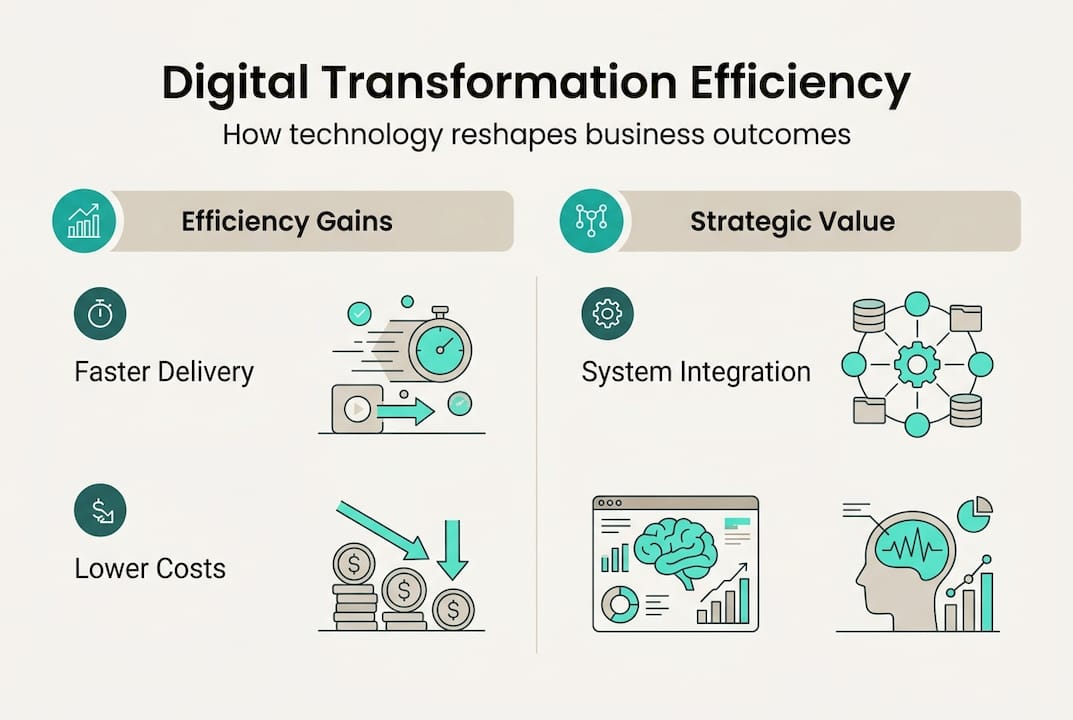
The transformation extends beyond individual processes to create systemic advantages. When your quoting system integrates seamlessly with inventory management, production scheduling, and supplier networks, you gain end-to-end visibility that enables proactive rather than reactive management. This holistic view allows you to identify optimization opportunities that remain invisible in siloed operations.
Pro Tip: Start your transformation journey by identifying one high-impact, low-complexity process where digitization can deliver quick wins. Early successes build organizational confidence and provide practical learning before tackling more complex enterprise-wide changes.
Understanding the returns and risks of digital transformation investments
Financial returns from digital transformation can be substantial when executed properly. UK organizations implementing AI automation achieve average 3.2x ROI within 18 months, with a median payback period of just 8 months for well-scoped initiatives. These returns stem from labor cost reductions, increased throughput, improved customer retention, and new revenue opportunities enabled by digital capabilities. However, the same research reveals that firms lose 27% of potential value due to execution gaps between planning and implementation.

This value leakage occurs through several mechanisms. Poorly defined requirements lead to expensive rework and scope creep. Inadequate change management results in low user adoption rates that undermine intended benefits. Technical integration challenges create workarounds that perpetuate inefficiencies rather than eliminating them. Each gap compounds, turning promising business cases into disappointing outcomes that erode leadership confidence in future initiatives.
The risk landscape extends beyond financial underperformance. Digital transformation initiatives face a 70% failure rate according to research from McKinsey and the London School of Economics. Primary failure drivers include:
- Legacy system integration complexity that underestimated technical debt and interdependencies
- Political resistance from stakeholders who perceive threats to established power structures or job security
- Inadequate stakeholder engagement that fails to address frontline worker concerns and workflow realities
- Unrealistic timelines that force compromises in testing, training, and change management
- Excessive investment in technology without corresponding process redesign or capability building
The sociotechnical dimension deserves particular attention. Digital transformation doesn't just change systems but fundamentally alters how people work, make decisions, and interact with colleagues and customers. Frontline workers bear what researchers call the "bodily cost" of transformation, learning new interfaces, adapting to changed workflows, and managing the stress of uncertainty during transition periods. When leadership fails to acknowledge and support these human dimensions, even technically sound implementations falter.
| Risk Category | Impact Level | Mitigation Priority |
|---|---|---|
| Legacy integration | High | Conduct thorough technical assessment before commitment |
| Stakeholder resistance | High | Invest heavily in change management and communication |
| Execution gaps | Medium | Use phased approaches with clear success metrics |
| Excessive investment | Medium | Start small, prove value, then scale incrementally |
Pro Tip: Before committing to large-scale transformation, honestly assess your organization's "bodily cost" capacity. Choose initial projects with manageable change impact that allow teams to build confidence and capability before tackling more disruptive initiatives.
Best practices and methodologies for successful implementation
Successful digital transformation follows structured methodologies that balance ambition with pragmatism. The most effective approaches share common elements proven to increase success rates and accelerate value realization. These methodologies don't eliminate risk but provide frameworks for managing complexity systematically.
A comprehensive digital transformation methodology typically includes these sequential steps:
- Conduct discovery workshops with cross-functional stakeholders to identify pain points, opportunities, and success criteria
- Develop a strategic roadmap that prioritizes initiatives based on business impact, feasibility, and interdependencies
- Design detailed process maps for target state workflows, identifying required capabilities and integration points
- Implement pilot projects in controlled environments to validate assumptions and refine approaches
- Scale successful pilots incrementally, incorporating lessons learned and maintaining momentum
- Establish continuous improvement mechanisms that treat transformation as ongoing evolution rather than one-time project
The Made Smarter program and PACE framework demonstrate these principles in UK manufacturing contexts. Participating companies begin with facilitated workshops that create shared understanding across technical and business stakeholders. They then develop phased roadmaps that break transformation into manageable sprints, each delivering tangible value while building toward the larger vision.
Implementation approaches vary based on organizational context and risk tolerance:
| Approach | Scope | Timeline | Best For |
|---|---|---|---|
| Pilot | Single process or department | 3-6 months | Testing concepts, building capability, proving value |
| Phased scale | Multiple related processes | 12-18 months | Balancing risk with meaningful impact |
| Enterprise-wide | Organization-wide transformation | 24+ months | Mature organizations with strong change capacity |
Agile iterative sprints form the operational backbone of effective implementation. Rather than attempting to define every requirement upfront, agile approaches deliver working capabilities in short cycles, typically two to four weeks. Each sprint produces demonstrable progress that stakeholders can evaluate and provide feedback on, enabling course corrections before significant resources are committed. This iterative rhythm maintains momentum while accommodating the inevitable discoveries and adjustments that emerge during complex change initiatives.
Leadership engagement determines whether methodologies succeed or become empty process theater. Executives must actively sponsor transformation, removing organizational barriers, resolving resource conflicts, and reinforcing the vision when implementation challenges create pressure to revert to familiar patterns. Equally important, leaders must model the behaviors they expect, demonstrating willingness to work differently and acknowledging the difficulty of change.
Change management deserves equal investment with technical implementation. Successful transformations dedicate substantial resources to communication, training, and support systems that help people navigate transitions. This includes creating transformation champions within business units, providing hands-on coaching during cutover periods, and celebrating early wins that demonstrate tangible benefits. You might explore how to launch SaaS MVP fast for insights on rapid validation approaches.
Navigating challenges and avoiding common pitfalls
Legacy technology creates the most persistent implementation challenges. Most UK organizations operate hybrid environments where modern cloud applications must integrate with decades-old core systems built on obsolete platforms, undocumented customizations, and brittle interfaces. These systems contain critical business logic and historical data that cannot be easily replaced, yet their technical limitations constrain what new capabilities can achieve. The integration complexity multiplies when multiple legacy systems must communicate through the new digital layer.
Political complexity compounds technical challenges. Digital transformation redistributes power, visibility, and control within organizations. Departments that previously controlled information flows may resist systems that increase transparency. Middle managers whose expertise centered on navigating inefficient processes may perceive automation as threatening their value. These dynamics create subtle and overt resistance that undermines implementation regardless of technical merit.
The sociotechnical risks extend to frontline workers who experience the most direct workflow disruption. Research on bodily cost reveals that workers face significant stress adapting to new systems, particularly when implementations provide inadequate training or fail to accommodate the tacit knowledge embedded in existing practices. When digital systems don't account for real-world workflow variations, workers develop workarounds that perpetuate inefficiencies the transformation intended to eliminate.
Excessive investment paradoxically increases failure risk. Organizations that commit massive budgets to comprehensive transformations create pressure for rapid results that discourage the experimentation and learning necessary for success. Large investments also make it politically difficult to acknowledge problems early or change direction when initial approaches prove flawed. The sunk cost fallacy keeps failing initiatives alive long past when they should be restructured or terminated.
UK public sector digital transformation failures illustrate these pitfalls vividly. The NHS digital program suffered from governance drift, where initial objectives evolved repeatedly without corresponding adjustments to architecture or resources. The Care Quality Commission's IT transformation collapsed under the weight of unrealistic timelines, inadequate stakeholder engagement, and underestimated integration complexity. These high-profile failures share common patterns:
"The fundamental lesson from public sector failures is that technology implementation succeeds or fails based on organizational readiness, not technical capability. Even the most sophisticated systems cannot overcome inadequate change management, unclear governance, or disconnected stakeholder groups."
Actionable steps to mitigate common pitfalls include:
- Conduct honest technical debt assessments before committing to timelines or budgets, involving engineers who understand legacy system realities
- Establish clear governance structures with defined decision rights and escalation paths to prevent drift and resolve conflicts quickly
- Invest in change management from day one, treating it as equally important as technical implementation
- Create feedback mechanisms that surface implementation problems early, rewarding transparency over optimistic reporting
- Start with limited scope pilots that prove value and build capability before scaling to enterprise-wide deployment
- Plan for the bodily cost by providing extensive hands-on training, support resources during cutover, and mechanisms to capture frontline worker feedback
The most successful transformations treat challenges as inevitable rather than exceptional. They build resilience through phased approaches, maintain flexibility to adjust course based on learning, and create psychological safety that encourages honest problem-solving rather than defensive concealment.
Empower your digital transformation with Mighty Sky Technologies
Navigating the complexities outlined throughout this article requires both strategic vision and practical execution expertise. Mighty Sky Technologies Limited brings proven experience helping UK organizations successfully implement digital transformation initiatives that deliver measurable operational improvements while avoiding the common pitfalls that derail 70% of projects. Our approach aligns directly with the evidence-based methodologies discussed, combining technical depth in cloud computing, cybersecurity, and IT infrastructure with the change management and stakeholder engagement capabilities essential for sustainable transformation.

We work as your trusted partner throughout the transformation journey, from initial discovery workshops and strategic roadmapping through phased implementation and continuous optimization. Our team understands the unique challenges UK enterprises face, including legacy system integration, regulatory compliance, and the sociotechnical dimensions that determine whether digital initiatives succeed or fail. Whether you're beginning your transformation journey or recovering from previous setbacks, Mighty Sky Technologies provides the expertise and support to turn digital ambitions into operational reality. Contact us to explore how we can tailor solutions to your specific business context and transformation goals.
What is digital transformation and why is it important?
Digital transformation represents the strategic integration of digital technologies across all business areas to fundamentally improve performance, customer experience, and competitive positioning. It goes beyond simple technology upgrades to encompass process redesign, cultural change, and new business models enabled by digital capabilities. For UK organizations, transformation is critical because it directly enhances operational efficiency through automation, provides agility to respond to market changes, and creates competitive advantages that traditional approaches cannot match. The importance stems from measurable outcomes like reduced cycle times, improved resource utilization, and data-driven decision-making that compound over time.
What are common challenges companies face during digital transformation?
Legacy system integration creates the most persistent technical challenge, as modern applications must connect with decades-old platforms built on obsolete technology and undocumented customizations. High failure rates, affecting 70% of initiatives, result primarily from poor planning, inadequate stakeholder engagement, and underestimated complexity. Cultural and technical resistance compounds these difficulties, as employees struggle to adapt workflows, middle managers perceive threats to established roles, and organizational politics create barriers to necessary changes. The sociotechnical dimension, including the bodily cost workers experience adapting to new systems, often receives insufficient attention during planning.
How can businesses maximize return on investment from digital transformation?
Phased agile approaches deliver the highest ROI by proving value incrementally while building organizational capability and confidence before scaling to enterprise-wide deployment. Focus on operational and strategic KPIs beyond purely financial metrics, measuring improvements in cycle time, quality, customer satisfaction, and employee productivity that create sustainable competitive advantages. Full engagement from leadership and stakeholders is essential, requiring active sponsorship that removes barriers, resolves conflicts, and reinforces transformation vision when implementation challenges emerge. Starting with high-impact, low-complexity processes generates quick wins that fund subsequent phases while providing practical learning.
What role does leadership play in successful digital transformation?
Leadership drives the vision, engagement, and cultural change necessary for transformation success, setting strategic direction while creating organizational conditions that enable effective execution. Executives must actively sponsor initiatives by removing barriers, resolving resource conflicts, and modeling the behavioral changes they expect from others. Leadership commitment is critical to overcoming the political resistance and change fatigue that emerge during complex implementations. Sustaining transformation requires leaders who treat digital evolution as ongoing capability building rather than one-time projects, establishing governance structures and continuous improvement mechanisms that outlast initial implementation phases.