
Many organizations believe their existing cybersecurity measures provide adequate protection, but this assumption is dangerously outdated. Cyber threats are evolving faster than traditional defenses can adapt, leaving even well-protected organizations vulnerable to sophisticated attacks. Understanding the emerging cybersecurity trends shaping 2026 is no longer optional for IT professionals and corporate decision-makers in the UK. This article explores the critical trends transforming organizational security, from Zero Trust Architecture to AI-powered threat detection, and provides practical guidance on building resilient defenses. You'll discover how to align your security strategy with regulatory requirements while implementing cutting-edge technologies that protect against tomorrow's threats.
Table of Contents
- Key Takeaways
- Understanding the evolving threat landscape
- Key cybersecurity trends shaping 2026 defenses
- Navigating regulatory and compliance landscapes for cybersecurity
- Building a resilient cybersecurity posture: practical steps for 2026
- Enhance your cybersecurity with Mighty Sky Technologies
- Frequently asked questions
Key Takeaways
| Point | Details |
|---|---|
| Adaptive defenses required | Threats are evolving rapidly, demanding defenses that adapt beyond static security checklists. |
| Zero Trust and AI | Zero Trust architecture paired with AI powered threat detection is shaping 2026 security strategies. |
| IoT and remote work risks | The explosion of IoT devices and remote work expands attack surfaces that require stronger device security and network controls. |
| Proactive threat intelligence | Continuous threat intelligence monitoring enables automated responses to emerging campaigns before they strike. |
| Regulatory compliance focus | Organizations must align security strategies with regulatory requirements and integrate risk management across the enterprise. |
Understanding the evolving threat landscape
The cybersecurity challenges facing UK organizations in 2026 bear little resemblance to threats from just five years ago. Advanced persistent threats have become more sophisticated, with attackers spending months inside networks before executing devastating ransomware campaigns. These prolonged intrusions allow threat actors to map your entire infrastructure, identify your most valuable assets, and exfiltrate data before encryption begins.
Phishing attacks have evolved beyond obvious spelling errors and suspicious links. Modern social engineering campaigns leverage AI-generated content that mimics executive communication styles with alarming accuracy. Attackers research your organization's hierarchy, recent projects, and communication patterns to craft messages that even security-aware employees struggle to identify as malicious. The psychological manipulation techniques deployed in 2026 exploit human trust and urgency in ways traditional email filters cannot detect.
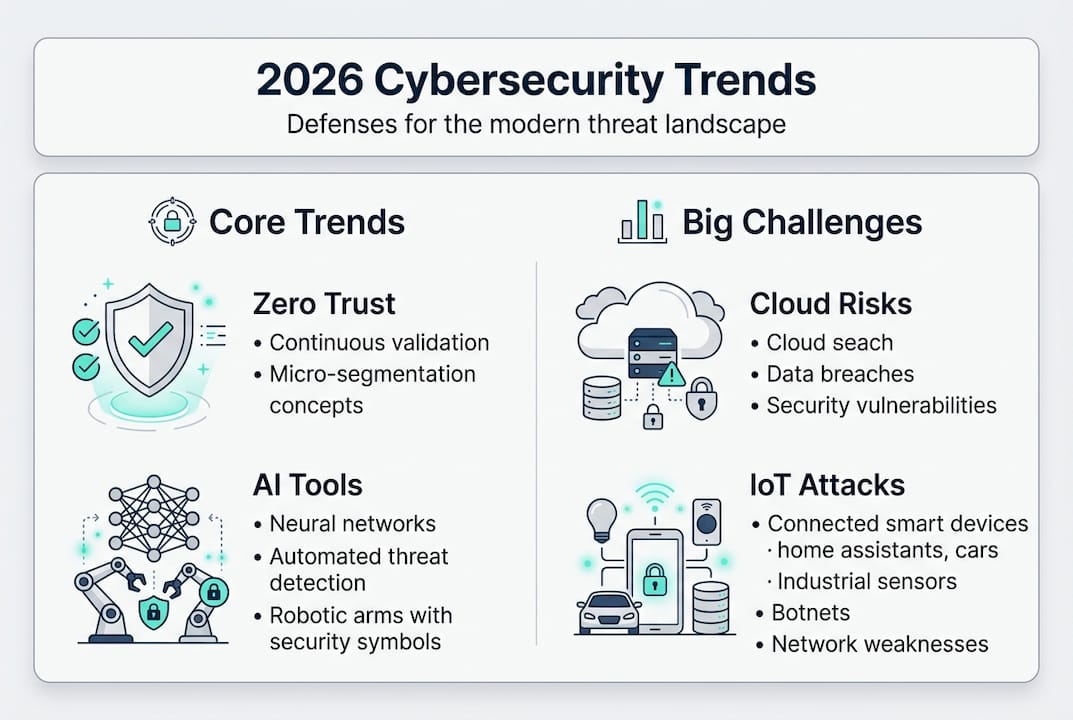
The explosion of Internet of Things devices has created countless new attack vectors. Smart building systems, connected manufacturing equipment, and even office coffee machines now represent potential entry points for cybercriminals. Many IoT devices ship with default credentials that organizations never change, creating easy access for attackers scanning networks for vulnerable endpoints. These devices often lack basic security features like encryption or automatic updates, making them perfect footholds for lateral movement.
Traditional perimeter-based security models assume threats come from outside your network. This assumption fails in an era where remote work blurs organizational boundaries and insider threats pose significant risks. Cyber threats are growing in complexity and frequency, requiring advanced defense mechanisms that recognize trust as a vulnerability rather than a security feature. Perimeter defenses become irrelevant when employees access corporate resources from coffee shops, home networks, and coworking spaces across multiple countries.
Proactive threat intelligence has become essential for staying ahead of attackers. Organizations can no longer wait for attacks to occur before responding. Continuous monitoring of dark web forums, threat actor communications, and vulnerability disclosures provides early warning of campaigns targeting your industry. Integrating threat intelligence feeds with security operations enables automated responses to emerging threats before they reach your network.
"The question is no longer if you'll be attacked, but when and how prepared you'll be to respond. Organizations that treat cybersecurity as a static checklist rather than a continuous process will find themselves perpetually behind threat actors who innovate daily."
Key cybersecurity trends shaping 2026 defenses
Zero Trust Architecture represents the most significant shift in security philosophy over the past decade. Unlike traditional models that trust users and devices inside the network perimeter, Zero Trust assumes every access attempt could be malicious. This approach requires continuous verification of user identity, device health, and contextual factors before granting access to resources. Organizations implementing Zero Trust reduce their attack surface by segmenting networks and limiting lateral movement opportunities for attackers who breach initial defenses.
The benefits extend beyond threat prevention. Zero Trust Architecture and AI integration are critical trends in 2026 cybersecurity strategies that enable granular access controls based on job roles, device types, and risk levels. When an employee's laptop shows signs of compromise, Zero Trust systems automatically restrict access to sensitive resources without disrupting their ability to perform low-risk tasks. This adaptive approach balances security with productivity in ways perimeter defenses never could.
Artificial intelligence and machine learning have transformed threat detection from reactive to predictive. Modern AI systems analyze billions of events daily, identifying patterns that indicate emerging attacks long before human analysts could spot them. Machine learning models trained on your organization's normal behavior establish baselines that make anomalies immediately visible. When a user account suddenly accesses unusual file types or connects from unexpected locations, AI-powered systems flag these deviations for investigation or automatic response.

Cloud security challenges have evolved as organizations migrate critical workloads to public, private, and hybrid environments. The shared responsibility model means cloud providers secure the infrastructure while you remain responsible for data, applications, and access management. Many breaches occur because organizations misunderstand where provider responsibility ends and theirs begins. Misconfigured storage buckets, overly permissive access policies, and unencrypted data remain common vulnerabilities in cloud deployments.
Automated security orchestration and response platforms have become essential for managing the volume of security events modern organizations generate. These systems integrate with existing security tools, correlating alerts from firewalls, endpoint protection, and intrusion detection systems into coherent incident narratives. Automation handles routine responses like isolating compromised devices or blocking malicious IP addresses, freeing security teams to focus on complex investigations requiring human judgment.
| Traditional Security | Zero Trust Approach |
|---|---|
| Trust internal users | Verify every access |
| Perimeter focused | Identity focused |
| Static policies | Dynamic policies |
| Network segmentation | Micro-segmentation |
| Manual responses | Automated responses |
Pro Tip: When deploying Zero Trust, start with your most critical assets rather than attempting organization-wide implementation immediately. This focused approach delivers quick wins, builds stakeholder confidence, and allows your team to refine processes before expanding scope. Many organizations fail by trying to boil the ocean, creating complexity that undermines both security and user experience.
Navigating regulatory and compliance landscapes for cybersecurity
The regulatory environment surrounding cybersecurity has intensified significantly, with UK organizations facing overlapping requirements from domestic and international frameworks. The General Data Protection Regulation remains the cornerstone of data protection requirements, imposing strict obligations on how you collect, process, and protect personal information. GDPR's extraterritorial reach means even organizations without EU operations must comply when processing EU citizen data, making it effectively a global standard.
The Network and Information Systems Regulations apply to operators of essential services and digital service providers, mandating specific security measures and incident reporting timelines. Organizations covered by NIS must implement appropriate technical and organizational measures to manage security risks, with penalties for non-compliance reaching significant percentages of annual turnover. Understanding whether your organization falls under NIS scope requires careful analysis of your services and their criticality to economic and societal activities.
Emerging UK-specific cybersecurity legislation reflects the government's recognition that data protection alone cannot address modern security challenges. New frameworks focus on supply chain security, requiring organizations to assess and manage risks introduced by third-party vendors and service providers. Regulatory compliance is a vital element of corporate cybersecurity strategy in 2026, extending responsibility beyond your direct operations to encompass the entire ecosystem supporting your business.
Compliance challenges multiply as organizations operate across jurisdictions with conflicting requirements. What satisfies UK regulators may fall short of requirements in other markets, forcing you to implement the highest common denominator of security controls. Data localization requirements in some jurisdictions conflict with cloud strategies that distribute data globally for resilience and performance. Navigating these contradictions requires legal expertise combined with technical understanding of how data flows through your systems.
Continuous compliance monitoring has replaced annual audits as the standard for demonstrating regulatory adherence. Modern compliance platforms automatically collect evidence of security controls, track policy acknowledgments, and document incident responses in real time. This continuous approach reduces the scramble before audits while providing ongoing assurance that controls remain effective. When regulations change, automated monitoring quickly identifies gaps requiring remediation.
Pro Tip: Treat compliance as a competitive advantage rather than a burden. Organizations that exceed minimum requirements and communicate their security posture transparently differentiate themselves when competing for security-conscious customers. Publishing security certifications, audit reports, and incident response procedures builds trust that translates directly into business opportunities, particularly in sectors like finance and healthcare where security concerns influence purchasing decisions.
Building a resilient cybersecurity posture: practical steps for 2026
Implementing Zero Trust and AI-powered security requires methodical planning rather than wholesale replacement of existing systems. Begin by mapping your critical assets and the data flows connecting them. Understanding what needs protection and how information moves through your organization reveals where to focus initial Zero Trust implementations. Identify the crown jewels that would cause maximum damage if compromised, then build security controls around those assets first.
Employee training programs must evolve beyond annual compliance videos that employees click through without engagement. Modern security awareness training uses simulated phishing campaigns that adapt to individual susceptibility levels. Employees who consistently identify threats receive advanced scenarios, while those who struggle get additional coaching and simpler tests. This personalized approach builds genuine security instincts rather than checkbox compliance. Effective cybersecurity posture requires combining technology, processes, and people strategies that recognize humans as both the weakest link and your best defense when properly trained.
Regular risk assessments identify emerging vulnerabilities before attackers exploit them. Quarterly reviews of your threat landscape, technology changes, and business operations reveal shifts in risk profiles requiring security adjustments. When your organization adopts new cloud services, acquires another company, or enters new markets, each change introduces security implications that risk assessments surface. Treating risk assessment as a continuous process rather than an annual event keeps your security strategy aligned with organizational reality.
Incident response planning determines whether a security event becomes a minor inconvenience or an existential crisis. Your plan should define clear roles, communication protocols, and decision-making authority before incidents occur. Conduct tabletop exercises that simulate realistic scenarios, testing whether your team can execute the plan under pressure. These exercises often reveal gaps in authority, unclear responsibilities, or missing technical capabilities that you can address before facing real attacks.
Investment in advanced monitoring and analytics provides the visibility needed to detect and respond to threats quickly. Security information and event management systems aggregate logs from across your infrastructure, applying analytics that identify suspicious patterns. Endpoint detection and response tools provide detailed visibility into activities on individual devices, enabling rapid containment when compromise occurs. Network traffic analysis reveals anomalous communication patterns indicating command and control activity or data exfiltration.
- Conduct a comprehensive asset inventory identifying all systems, data, and connections requiring protection
- Implement multi-factor authentication across all access points, prioritizing administrative and remote access
- Deploy endpoint detection and response tools on all devices accessing corporate resources
- Establish a security operations center or engage a managed security service provider for 24/7 monitoring
- Create and test incident response playbooks for common scenarios like ransomware and data breaches
- Implement automated patch management ensuring critical vulnerabilities receive updates within 48 hours
- Conduct regular penetration testing and vulnerability assessments by qualified third parties
- Develop supply chain security requirements for vendors handling sensitive data or providing critical services
| Security Investment | Typical Cost Range | Primary Benefit | ROI Timeline |
|---|---|---|---|
| Zero Trust Implementation | £50,000-£200,000 | Reduced attack surface | 12-18 months |
| AI Threat Detection | £30,000-£100,000 annually | Faster threat identification | 6-12 months |
| Security Awareness Training | £50-£150 per employee | Reduced human error | 3-6 months |
| Managed Security Services | £5,000-£20,000 monthly | 24/7 monitoring and response | Immediate |
| Incident Response Planning | £20,000-£50,000 | Minimized breach impact | Immediate |
Enhance your cybersecurity with Mighty Sky Technologies
Navigating the complex cybersecurity landscape of 2026 requires expertise that many organizations lack internally. Mighty Sky Technologies specializes in helping UK organizations implement robust security strategies tailored to your specific threats, compliance requirements, and business objectives. Our team brings deep experience in Zero Trust Architecture, AI-powered threat detection, and cloud security frameworks that protect modern distributed environments.

We understand that effective cybersecurity balances protection with productivity, implementing controls that defend against threats without frustrating users or impeding business operations. Our approach begins with comprehensive risk assessments that identify your unique vulnerabilities, then develops prioritized roadmaps addressing the most critical gaps first. Whether you need help achieving regulatory compliance, responding to active incidents, or building long-term security capabilities, Mighty Sky Technologies provides the expertise and support your organization needs to thrive securely in an increasingly hostile digital environment.
Frequently asked questions
What is Zero Trust Architecture, and why is it important?
Zero Trust Architecture eliminates the concept of trusted internal networks, requiring verification for every access attempt regardless of source. This approach assumes that breaches will occur and focuses on minimizing damage by restricting lateral movement and implementing least-privilege access controls. It protects against both external attackers and malicious insiders by treating trust as a vulnerability rather than a security feature. Organizations implementing Zero Trust significantly reduce their attack surface and limit the potential impact of successful breaches.
How can AI improve my organization's cybersecurity?
Artificial intelligence enhances threat detection by analyzing patterns across billions of security events, identifying anomalies that indicate emerging attacks before they cause damage. AI systems learn your organization's normal behavior, making deviations immediately visible for investigation or automated response. Machine learning models continuously improve as they process more data, becoming increasingly accurate at distinguishing genuine threats from false positives. This capability enables faster incident response through automation, freeing security teams to focus on complex investigations requiring human judgment.
What cybersecurity regulations should UK organizations focus on in 2026?
UK organizations must prioritize compliance with GDPR for data protection, NIS Regulations for critical infrastructure security, and emerging legislation addressing supply chain risks and incident reporting. Industry-specific regulations like those governing financial services and healthcare impose additional requirements beyond general frameworks. Maintaining compliance builds stakeholder trust, reduces legal and financial risks, and often satisfies customer security requirements during procurement processes. Organizations should conduct regular compliance assessments ensuring their security programs address all applicable regulatory obligations.
How often should we conduct cybersecurity risk assessments?
Quarterly risk assessments provide the frequency needed to identify emerging threats and vulnerabilities in today's rapidly evolving landscape. Major organizational changes like mergers, new technology deployments, or market expansions should trigger immediate assessments regardless of schedule. Continuous monitoring supplements periodic assessments by providing real-time visibility into your security posture. This combination of scheduled reviews and ongoing monitoring ensures your security strategy remains aligned with current risks rather than addressing outdated threats.
What is the biggest cybersecurity mistake organizations make?
Treating cybersecurity as a one-time project rather than a continuous process represents the most damaging mistake organizations make. Security requires ongoing investment in technology updates, employee training, and process refinement as threats evolve. Organizations that implement controls then neglect maintenance find their defenses quickly become obsolete against new attack techniques. Successful security programs treat cybersecurity as a core business function requiring sustained attention and resources, not an IT problem solved through occasional technology purchases.