
TL;DR:
- Many UK organizations regret full public cloud adoption due to compliance issues and unpredictable costs.
- Hybrid cloud offers flexible, controlled, and cost-effective integration of private and public environments.
- Market growth is driven by regulatory demands, AI workloads, and evolution in data sovereignty requirements.
Most UK organizations that went all-in on public cloud expected lower costs, faster innovation, and fewer headaches. What many got instead was compliance friction, unpredictable billing, and a growing sense that they had handed over too much control. 67% wish they had started with hybrid cloud rather than a full public cloud model. That single statistic should give any IT leader pause. This article cuts through the noise around hybrid cloud, explains what it actually delivers for UK enterprises, and shows how to use it as a practical engine for digital transformation rather than just another infrastructure trend.
Table of Contents
- Understanding hybrid cloud: The new UK enterprise standard
- Key benefits of hybrid cloud: Flexibility, control, and cost management
- Hybrid cloud and security: Meeting UK compliance and sovereignty needs
- Hybrid cloud vs. multi-cloud: Avoiding lock-in and optimizing strategy
- Hybrid cloud adoption trends and outlook for 2026 and beyond
- Our take: Hybrid cloud wisdom learned from UK transformation journeys
- Next steps: Partnering for hybrid cloud success
- Frequently asked questions
Key Takeaways
| Point | Details |
|---|---|
| Hybrid is now mainstream | Most UK enterprises now consider hybrid cloud essential for balancing flexibility and compliance. |
| Flexibility with control | Hybrid cloud enables phased modernization and cost control without compromising legacy systems. |
| Focus on security | Meeting the NCSC 14 principles is easier with hybrid setups, giving confidence for regulated industries. |
| Future-proof strategy | Hybrid and multi-cloud approaches together are key to avoiding lock-in as market needs evolve. |
Understanding hybrid cloud: The new UK enterprise standard
Hybrid cloud is not simply a mix of two environments bolted together. At its core, it is an integrated architecture that connects private cloud or on-premises infrastructure with one or more public cloud platforms, managed through a unified control layer. Workloads move between environments based on cost, performance, compliance, or security requirements. That flexibility is the point.
To understand why hybrid matters, it helps to contrast it with the alternatives:
| Feature | Public cloud | Private cloud | Hybrid cloud |
|---|---|---|---|
| Cost model | Pay-as-you-go, variable | High upfront capex | Balanced, optimized |
| Data control | Limited | Full | Selective |
| Compliance fit | Challenging | Strong | Strong |
| Scalability | Very high | Limited | High |
| Migration complexity | Low initially | High | Moderate |
The table above makes one thing clear: hybrid cloud is not a compromise. It is a deliberate design choice that gives you the best attributes of both models without forcing you into the worst trade-offs of either.
Key drivers pushing UK organizations toward hybrid include:
- Regulatory pressure: GDPR, FCA rules, and NHS data governance all demand tight control over where sensitive data lives.
- Legacy infrastructure: Many UK enterprises have significant on-premises investments that cannot simply be abandoned.
- Cost unpredictability: Public cloud egress fees and storage costs have caught many finance teams off guard.
- Operational continuity: Phased migration reduces risk and keeps critical systems running during transformation.
The cloud computing for transformation case is well established, but the approach matters enormously. The UK cloud guide shows that the industry has clearly shifted from cloud-first to a more measured, cloud-smart posture. Hybrid is not a step backward. It is the mature next step.
"Cloud-smart means choosing the right cloud for the right workload, not defaulting to public cloud for everything."
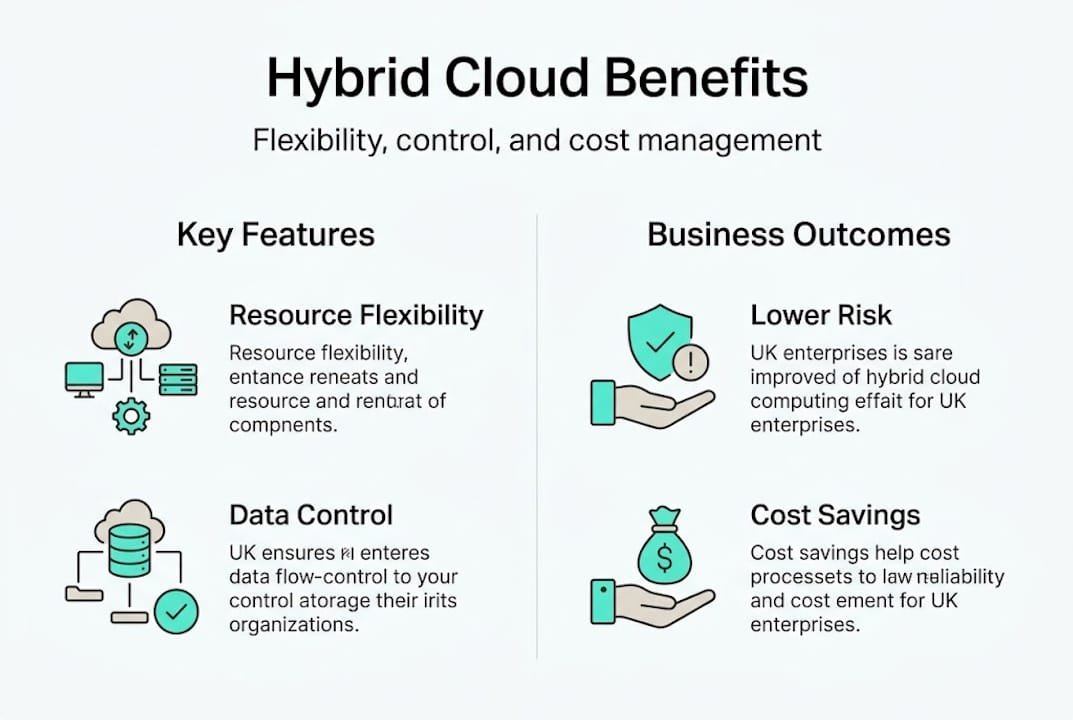
Key benefits of hybrid cloud: Flexibility, control, and cost management
Once you understand the model, the business case becomes concrete. Hybrid cloud delivers measurable advantages across four dimensions that matter most to UK IT leaders: flexibility, governance, cost, and transformation pace.
Flexible resource allocation is the headline benefit. You can run steady-state workloads on predictable on-premises infrastructure while bursting to public cloud for seasonal demand spikes, development environments, or analytics jobs. A retailer processing Black Friday traffic does not need to own the compute capacity for that peak year-round. Hybrid makes that elasticity practical.
Governance and data control are equally important. Sensitive customer data, financial records, and intellectual property can stay on-premises or in a private cloud where your team controls access, encryption, and audit trails. Less sensitive workloads move to public cloud where speed and scale are the priority.

| Business need | Best environment | Hybrid advantage |
|---|---|---|
| Customer PII storage | Private or on-prem | Keeps data sovereign |
| Dev and test environments | Public cloud | Fast, cheap, disposable |
| Analytics and reporting | Public cloud | Scalable compute on demand |
| Core ERP or CRM | On-prem or private | Stability and control |
| Disaster recovery | Public cloud | Cost-effective standby |
Cost management is where hybrid often surprises people. Yes, there is complexity overhead, but organizations that plan carefully avoid the egress cost traps and over-provisioning that plague pure public cloud deployments. You pay for public cloud when you need it, and you leverage existing on-premises investments for everything else.
Pro Tip: Before migrating any workload, classify it by sensitivity, performance requirement, and usage pattern. That three-factor analysis alone will tell you where each workload belongs in a hybrid model.
Finally, hybrid enables phased migration for IT teams that cannot afford big-bang cutover. Phased migration supports transformation without breaking legacy systems that the business depends on daily. The result is digital transformation efficiency that compounds over time rather than creating a single high-risk event.
- Audit current workloads and classify by sensitivity and performance needs.
- Identify quick wins: dev/test environments are ideal first movers to public cloud.
- Establish connectivity between environments using secure, low-latency links.
- Migrate in waves, validating performance and compliance at each stage.
- Optimize continuously as usage patterns become clearer post-migration.
Hybrid cloud and security: Meeting UK compliance and sovereignty needs
Security is where hybrid cloud earns its keep for UK organizations. The regulatory landscape here is genuinely demanding, and public cloud alone often cannot satisfy it without significant additional investment and complexity.
The NCSC 14 Cloud Security Principles provide the authoritative framework for evaluating any cloud deployment in the UK. These principles cover data-in-transit protection, asset management, supply chain security, and secure user management, among others. Hybrid architectures, when designed correctly, can satisfy all 14 principles by keeping the most sensitive data and processes under direct organizational control.
Key compliance considerations for UK hybrid deployments:
- Data residency: Keep regulated data within UK or EU boundaries to satisfy GDPR and sector-specific rules.
- Access control: Centralize identity management across both environments using tools like Azure Active Directory or similar platforms.
- Encryption: Enforce encryption at rest and in transit across all environments, with keys managed on-premises where required.
- Audit logging: Maintain unified audit trails that span both private and public cloud components for incident response and regulatory reporting.
- Vendor assessment: Apply UK business cybersecurity standards when evaluating public cloud providers as part of your supply chain.
Pro Tip: Map each of the NCSC 14 principles to specific technical controls in your hybrid architecture before you go live. This creates a defensible compliance posture and simplifies future audits considerably.
Data sovereignty is a growing concern, particularly for public sector and financial services organizations. Hybrid cloud lets you draw a clear line: this data stays here, under these controls, full stop. Public cloud handles everything else. That clarity is something a pure public cloud model struggles to provide without expensive private regions or dedicated tenancy agreements. For a deeper look at cloud compliance in the UK, the regulatory picture is only becoming more detailed as 2026 progresses.
Statistic callout: Organizations using hybrid cloud architectures report significantly stronger confidence in their ability to demonstrate compliance compared to those on pure public cloud, according to multiple UK sector surveys.
Hybrid cloud vs. multi-cloud: Avoiding lock-in and optimizing strategy
IT leaders often conflate hybrid cloud and multi-cloud, but they solve different problems. Getting this distinction right matters for your long-term architecture decisions.
Hybrid cloud connects on-premises or private infrastructure with public cloud. Multi-cloud uses two or more public cloud providers simultaneously, often to avoid dependence on any single vendor. You can run both strategies at once, and many large UK enterprises do exactly that.
Vendor lock-in is the core risk that both strategies address, but in different ways:
| Risk | Hybrid cloud approach | Multi-cloud approach |
|---|---|---|
| Single vendor dependency | Reduces via on-prem integration | Reduces via provider diversification |
| Data portability | Strong for on-prem workloads | Requires careful architecture |
| Cost negotiation leverage | Moderate | High |
| Operational complexity | Moderate | High |
| Compliance control | Strong | Variable |
Hybrid cloud balances lock-in risk while keeping on-premises integration intact. Multi-cloud goes further on vendor diversification but adds significant management overhead. Neither is universally better.
Here is how to think about the decision:
- If your primary concern is data sovereignty and legacy integration, start with hybrid.
- If you need best-of-breed services from multiple providers, layer in multi-cloud selectively.
- If operational simplicity is a priority, resist the urge to go multi-cloud before your team is ready.
- If resilience and avoiding single points of failure are critical, multi-cloud adds genuine value.
The cloud role in UK transformation is evolving rapidly, and IT infrastructure tips 2026 consistently point to the same conclusion: strategy before technology. Choose the model that fits your business needs, not the one generating the most vendor marketing noise.
Hybrid cloud adoption trends and outlook for 2026 and beyond
The numbers behind hybrid cloud adoption tell a clear story. The hybrid cloud market is projected to grow from $194 billion in 2026 to $348 billion by 2031, a compound annual growth rate of 12.37%. Sovereign cloud solutions are a primary driver, particularly across Europe where regulatory expectations are tightening.
| Year | Hybrid cloud market size | Key driver |
|---|---|---|
| 2026 | $194 billion | Sovereignty, regulation |
| 2028 | ~$245 billion (est.) | AI workload integration |
| 2031 | $348 billion | Multi-cloud maturity, compliance |
What is driving this growth beyond the headline numbers?
- Sovereign cloud demand: Governments and regulated industries want data kept within national boundaries, and hybrid enables that without sacrificing cloud capability.
- AI and analytics workloads: Large language models and data analytics require massive compute that bursts to public cloud, while training data stays on-premises for governance reasons.
- Edge computing integration: Hybrid architectures naturally extend to edge locations, supporting manufacturing, retail, and healthcare use cases.
- Regulatory evolution: As UK post-Brexit data rules mature, hybrid gives organizations the agility to adapt without re-architecting from scratch.
Statistic callout: The 12.37% CAGR for hybrid cloud significantly outpaces overall IT infrastructure growth, signaling that this is not a transitional phase but a long-term enterprise standard.
For UK IT leaders, the strategic implication is straightforward. 2026 tech trends point toward hybrid as the default architecture for any organization balancing innovation with compliance. Investing in efficiency and security solutions built on hybrid foundations now positions you to absorb future regulatory and technology changes without painful rework.
Our take: Hybrid cloud wisdom learned from UK transformation journeys
Here is something the vendor whitepapers rarely say out loud: pure public cloud is almost never the right answer for a mid to large UK enterprise. It is the right answer for startups that have no legacy, no regulatory burden, and no sensitive data to protect. That is a very specific profile.
For everyone else, hybrid cloud's so-called complexity cost is worth paying. The organizations we see struggle are not the ones managing hybrid environments. They are the ones who went all-public, hit a compliance wall eighteen months later, and are now doing expensive remediation work while trying to keep the lights on.
The real lesson from UK transformation journeys is that phased migration, done thoughtfully, beats big-bang cloud migration every time. The wins come from moving the right workloads first, building operational confidence, and expanding from there. The cloud transformation wisdom is not about which cloud you choose. It is about how deliberately you choose it.
Do not follow the trend. Follow your workload map.
Next steps: Partnering for hybrid cloud success
Moving from research to a working hybrid cloud strategy is where many organizations stall. The architecture decisions, vendor negotiations, compliance mapping, and migration sequencing all require experience that is hard to build from scratch.

At MightySkyTech, we work with UK enterprises at exactly this stage. Whether you are evaluating your first hybrid deployment or optimizing an existing environment, our team brings hands-on experience with the compliance requirements, infrastructure patterns, and business pressures that UK IT leaders face. We tailor every engagement to your organization's specific workloads, risk profile, and transformation goals. Explore how hybrid cloud solutions from MightySkyTech can accelerate your roadmap and reduce the risk of getting it wrong.
Frequently asked questions
What is the main reason UK organizations are switching to hybrid cloud?
UK organizations are moving to hybrid cloud to regain compliance control, improve workload flexibility, and avoid the cost surprises that come with pure public cloud adoption. 67% of UK companies say they wish they had started with hybrid rather than going all-public.
How does hybrid cloud help with regulatory compliance in the UK?
Hybrid cloud lets organizations keep sensitive data on-premises or in private environments, making it far easier to satisfy the NCSC 14 Cloud Security Principles and other UK-specific regulatory requirements without complex workarounds.
Does hybrid cloud cost less than public cloud?
Hybrid cloud is not always cheaper upfront, but it gives organizations far better cost control by matching workloads to the most cost-effective environment and avoiding the cloud cost overruns that catch many pure public cloud users off guard.
What is the outlook for hybrid cloud adoption?
The hybrid cloud market is on a strong growth trajectory, projected to reach $348 billion by 2031, driven by sovereign cloud demand, regulatory pressure, and the need to support AI and analytics workloads at scale.