
TL;DR:
- Moving to the cloud offers rapid deployment, improved collaboration, and cost-effective redundancy.
- Effective cloud management requires governance, cost tracking through FinOps, and understanding pricing models.
- Security must extend beyond basic encryption to include zero trust, compliance with data residency, and shared responsibility.
Many UK enterprises assume that moving to the cloud is straightforward: sign a contract, migrate workloads, and watch costs drop. Reality is messier. 67% of UK enterprises report higher-than-expected cloud costs, and security gaps often emerge precisely because decision-makers treated cloud as an IT project rather than a business transformation. If you are a corporate leader evaluating cloud investment, the stakes are too high for guesswork. This guide cuts through the noise and gives you a grounded, evidence-backed framework to capture real efficiency gains, manage costs predictably, and build a security posture that holds up under UK regulatory scrutiny.
Table of Contents
- The strategic value of cloud investment
- Understanding cloud cost dynamics and governance
- Securing the cloud: Beyond the basics
- Building a 'cloud-smart' strategy: Hybrid and multi-cloud in the UK
- The reality: Smart cloud investment is not just IT's concern
- Next steps: Leverage cloud with expert support
- Frequently asked questions
Key Takeaways
| Point | Details |
|---|---|
| Strategic efficiency boost | Cloud speeds up project launches and empowers collaboration, driving operational gains. |
| Cost control is essential | Many UK enterprises face unforeseen cloud costs, making robust cost governance and FinOps vital. |
| Security demands expertise | Cloud providers offer advanced security but require your business to address compliance and data responsibilities. |
| Hybrid strategies lead | Blending cloud and in-house resources meets both efficiency and data sovereignty needs in the UK. |
The strategic value of cloud investment
Cloud computing is not just about moving servers off-site. It fundamentally changes how fast your organization can respond to market shifts, launch new services, and support distributed teams. That speed advantage is measurable and significant.
Cloud provisioning enables new environments to go live in minutes rather than weeks, which means your development and operations teams spend less time waiting and more time building. Collaboration tools bundled with major cloud platforms, think shared workspaces, real-time document editing, and integrated video, directly boost productivity for teams spread across multiple UK offices or working remotely.
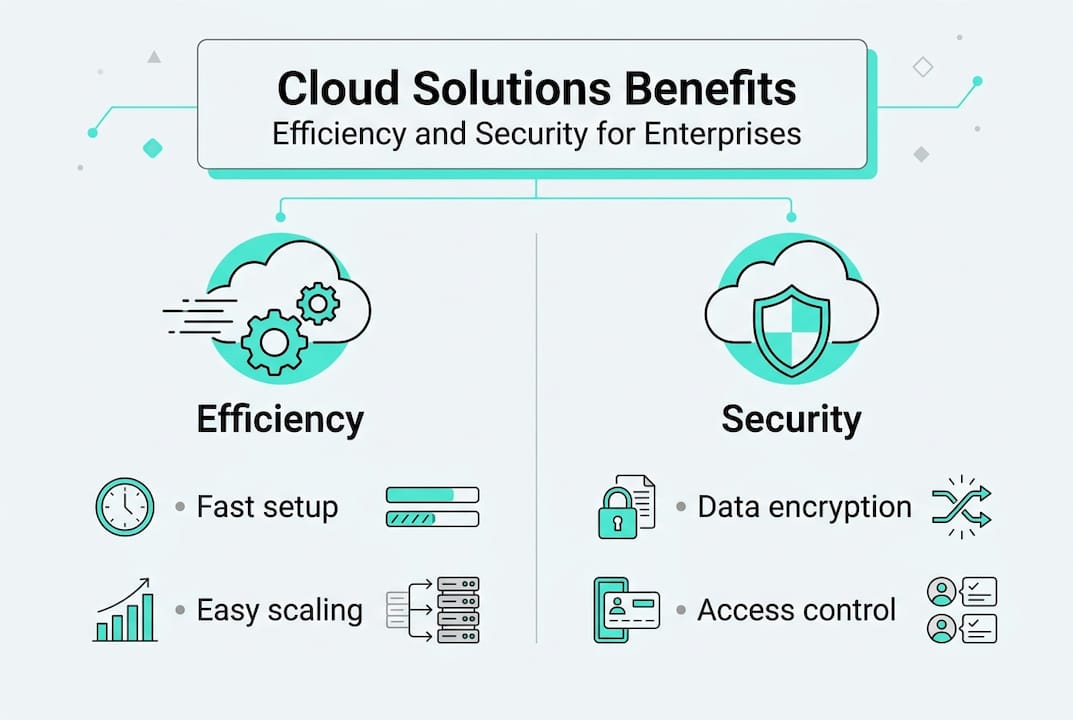
The efficiency gains extend well beyond speed. Cloud platforms support automated backups, self-healing infrastructure, and on-demand scaling, all of which reduce the manual overhead your IT team carries. Understanding the full digital transformation ROI helps you build the business case for leadership.
Core efficiency benefits of cloud adoption:
- Rapid provisioning of new environments without hardware procurement delays
- Built-in redundancy and disaster recovery at a fraction of on-premises cost
- Elastic scaling that matches compute resources to actual demand
- Centralized management dashboards that reduce operational complexity
- Integrated collaboration tools that cut communication friction across teams
| Business outcome | Traditional IT | Cloud model |
|---|---|---|
| New environment setup | 4 to 12 weeks | Minutes to hours |
| Disaster recovery readiness | High capital cost | Subscription-based, always on |
| Scaling to meet demand | Manual, slow | Automated, near-instant |
| Collaboration tooling | Separate licensing | Often bundled |
Pro Tip: Before migrating, map your current IT bottlenecks to specific cloud capabilities. This creates a measurable baseline so you can prove ROI to your board within the first 90 days.
For enterprises already running complex infrastructure, reviewing IT infrastructure tips before migration planning can prevent costly architectural mistakes down the line.
Understanding cloud cost dynamics and governance
Here is where many enterprises get into trouble. Cloud pricing models are variable by design. You pay for what you use, which sounds ideal until usage patterns shift, teams spin up resources without oversight, and your monthly bill doubles unexpectedly.
67% of UK enterprises report higher-than-expected cloud costs and are actively shifting their strategies as a result. The culprits are usually predictable: idle resources left running, over-provisioned storage, and a lack of tagging policies that make cost attribution impossible.
FinOps, short for Financial Operations, is the practice of bringing financial accountability into cloud spending. It is not a software tool. It is a cross-functional discipline that connects your engineering, finance, and business teams around shared visibility into cloud costs. Implementing FinOps means your CFO and your CTO are looking at the same data and making decisions together.
Steps to implement effective cloud cost governance:
- Establish a cloud cost baseline before migration begins
- Apply resource tagging policies so every workload maps to a cost center
- Set automated budget alerts at 70%, 85%, and 100% of monthly targets
- Conduct monthly FinOps reviews with engineering and finance stakeholders
- Evaluate reserved instances and savings plans for predictable workloads
Hybrid and multi-cloud models are also gaining traction among UK enterprises precisely because they offer more control. Keeping sensitive workloads on-premises while running scalable applications in the cloud lets you balance cost and compliance without sacrificing agility. Optimizing your infrastructure workflow optimization is a practical first step toward that balance.
| Cost factor | Traditional IT | Cloud model |
|---|---|---|
| Capital expenditure | High upfront | Minimal |
| Operating expenditure | Predictable but rigid | Variable, requires governance |
| Scaling costs | Expensive hardware upgrades | Pay-as-you-go |
| Idle resource waste | Fixed regardless of use | Avoidable with monitoring |
Pro Tip: Run a cloud cost simulation using your current workload data before committing to a provider. Most major providers offer free cost estimation tools that reveal your likely spend under different usage scenarios.
For a broader view of how to align technology spending with business outcomes, business technology optimization frameworks provide a useful structure.
Securing the cloud: Beyond the basics
Encryption at rest and in transit is table stakes. If your cloud security strategy stops there, you are leaving significant risk on the table. UK enterprises operating in regulated sectors, financial services, healthcare, legal, face additional scrutiny that demands a more sophisticated approach.

Cloud security improves significantly when enterprises leverage provider expertise and advanced frameworks like zero trust. Zero trust means no user, device, or system is trusted by default, even inside your network perimeter. Every access request is verified continuously, which dramatically reduces the blast radius of a compromised account.
Infrastructure as Code, or IaC, is another capability that elevates security. By defining your cloud environment in code, you can version-control your configurations, audit changes, and prevent configuration drift that creates vulnerabilities over time.
"Security in the cloud is a shared responsibility. Your provider secures the infrastructure. You are responsible for your data, your access controls, and your compliance posture."
Core cloud security mechanisms every UK enterprise should implement:
- Zero trust network access with continuous identity verification
- Multi-factor authentication enforced across all cloud accounts
- Data residency controls to meet UK GDPR and sector-specific requirements
- Infrastructure as Code for auditable, repeatable environment configuration
- Multi-region disaster recovery to maintain operations during outages
- Regular penetration testing and cloud security posture assessments
UK data residency is a particularly important consideration post-Brexit. Certain regulated data must remain within UK or EEA boundaries, and not all cloud providers make this straightforward to configure. Ensuring your provider offers UK-specific regions and that your contracts reflect data sovereignty requirements is non-negotiable. Understanding cybersecurity for UK businesses at the infrastructure level helps you ask the right questions of any cloud vendor.
Building a 'cloud-smart' strategy: Hybrid and multi-cloud in the UK
A cloud-smart strategy means choosing the right cloud model for each workload rather than defaulting to a single approach. Not every application belongs in a public cloud. Not every dataset can leave your data center. Acknowledging that reality is the starting point for a resilient architecture.
Hybrid models balance efficiency with control and help UK enterprises address cost and data sovereignty issues simultaneously. Multi-cloud goes one step further, distributing workloads across two or more public cloud providers to avoid vendor lock-in and optimize for price and performance by workload type.
Understanding the full range of hybrid and multi-cloud explained options is essential before committing to any architecture. The wrong model can lock you into a cost structure or compliance risk that is expensive to unwind.
Steps to build a cloud-smart strategy:
- Audit your current workloads and classify them by sensitivity, performance needs, and compliance requirements
- Identify which workloads are candidates for public cloud, private cloud, or on-premises retention
- Evaluate providers against UK data residency, SLA commitments, and total cost of ownership
- Define your governance framework before migration, not after
- Plan for interoperability so workloads can move between environments without re-engineering
- Establish a phased migration roadmap with clear success metrics at each stage
Reviewing available IT infrastructure options gives you a clearer picture of what architecture combinations are available and what trade-offs each involves.
Pro Tip: Avoid migrating everything at once. Start with a low-risk, high-visibility workload that lets you prove the model, refine your governance processes, and build internal confidence before tackling mission-critical systems. Detailed IT transformation strategies can help you sequence the migration correctly.
The reality: Smart cloud investment is not just IT's concern
Most cloud failures we see are not technical failures. They are governance failures. The decision to migrate was made by IT, the budget was approved by finance without full visibility into ongoing costs, and compliance was consulted only when an audit arrived. By then, the damage was done.
Cloud investment touches every part of your organization. Your CFO needs to understand variable cost models. Your COO needs to see how cloud enables or disrupts operational workflows. Your compliance and legal teams need a seat at the table before contracts are signed, not after.
The enterprises that extract the most value from cloud are those where the digital transformation strategy is owned at the board level and executed cross-functionally. Cloud becomes a competitive advantage when it is aligned with business outcomes, not just IT objectives. Treating it as a technical upgrade is how organizations end up with higher bills, fragmented architectures, and security gaps that only surface during incidents.
Next steps: Leverage cloud with expert support
Building a cloud strategy that delivers on efficiency, cost control, and security is achievable, but it requires more than good intentions. It requires structured planning, experienced guidance, and ongoing governance.
Mighty Sky Technologies works with UK enterprises to design, implement, and manage cloud strategies that are tailored to your specific workloads, regulatory environment, and growth objectives. Whether you are evaluating your first cloud migration or optimizing an existing multi-cloud architecture, our team brings the technical depth and commercial awareness to accelerate your results. Explore our approach to enterprise cloud transformation or contact us to schedule a consultation and start building a cloud strategy that actually delivers.
Frequently asked questions
What are the main risks of investing in cloud solutions for UK enterprises?
Main risks include uncontrolled costs, data residency compliance failures, and security gaps that emerge when cloud is treated as an IT-only project rather than a business-wide initiative. UK enterprises shifting strategy due to unexpected costs and regulatory pressures confirms these risks are widespread.
How can UK businesses manage cloud costs effectively?
Adopting a FinOps framework, enforcing resource tagging, and running regular spend audits gives finance and engineering teams shared visibility into cloud expenditure. FinOps for cost governance is increasingly recognized as the standard approach for predictable cloud budgeting.
What is a hybrid cloud, and why is it beneficial?
Hybrid cloud combines on-premises infrastructure with public or private cloud services, letting you keep sensitive workloads in-house while scaling other operations in the cloud. Hybrid models balance efficiency with control, which is particularly valuable for UK enterprises navigating data sovereignty requirements.
Do cloud providers handle all security responsibilities?
No. Cloud security is a shared responsibility: providers secure the underlying infrastructure, but your organization remains accountable for data protection, access management, and regulatory compliance.