
UK enterprises are grappling with rising infrastructure costs, unpredictable downtime, and systems that grow faster than the teams managing them. When a single cloud misconfiguration can cascade into hours of lost productivity, the pressure on IT managers is real and constant. This guide walks you through a structured, repeatable workflow for IT infrastructure optimization, covering everything from initial audits and automation to compliance, troubleshooting, and measurable outcomes. Whether you manage a hybrid environment or a legacy-heavy estate, each step here is designed to deliver tangible performance gains and cost control.
Table of Contents
- Assessing your current IT infrastructure: Preparation and prerequisites
- Step-by-step optimization workflow: From audit to automation
- Addressing UK compliance, legacy systems, and security pitfalls
- Troubleshooting and measuring results: Proving optimization success
- A smarter approach: Balancing agility and governance in UK enterprises
- Leverage expert solutions for seamless IT infrastructure optimization
- Frequently asked questions
Key Takeaways
| Point | Details |
|---|---|
| Workflow audit is essential | A structured audit forms the foundation for successful IT infrastructure optimization. |
| Automation drives efficiency | Automating tasks with tools like Terraform and Ansible minimizes manual errors and operational costs. |
| Compliance protects operations | Aligning with GDPR and Cyber Essentials secures and legitimizes IT infrastructure in the UK. |
| Continuous improvement is vital | Regular monitoring and iterative troubleshooting ensure ongoing optimization and business value. |
Assessing your current IT infrastructure: Preparation and prerequisites
Before you can optimize anything, you need an honest picture of what you have. Many IT teams underestimate how much technical debt and cloud sprawl accumulate over just two or three years. A proper infrastructure audit surfaces hidden costs, redundant systems, and capacity gaps that would otherwise quietly drain your budget.
Start by mapping your entire asset landscape, including on-premises hardware, cloud instances, SaaS subscriptions, and network dependencies. Look specifically for infrastructure types for efficiency that may be misaligned with current business demands. Legacy systems running workloads that could be virtualized, or cloud resources sitting idle, are common findings at this stage.
ITIL, COBIT, and TOGAF are established frameworks guiding best practices for infrastructure assessment. ITIL's Service Value System helps you align IT services to business outcomes. COBIT provides governance and risk controls. TOGAF structures the architectural thinking needed when planning migrations or consolidations. You don't need to implement all three simultaneously, but knowing which lens to apply at each audit phase saves significant time.
Here's a quick comparison to help you position your current environment:
| Environment type | Cost profile | Scalability | Compliance complexity | Best for |
|---|---|---|---|---|
| Legacy on-premises | High CapEx, low OpEx | Low | Moderate | Stable, predictable workloads |
| Cloud-native | Low CapEx, variable OpEx | High | High (data residency) | Agile, growth-focused teams |
| Hybrid | Mixed | Moderate to high | High | Most UK enterprises today |
For tools, consider platforms like SolarWinds, Lansweeper, or ServiceNow Discovery to automate asset mapping. Pair these with service management strategies that align your ITSM processes to the audit findings. Gartner's optimization methodologies also provide a useful benchmark for where enterprise IT teams typically focus first.
Your preparation checklist should include:
- Documented inventory of all hardware, software, and cloud assets
- Current capacity utilization reports (CPU, memory, storage, network)
- Compliance documentation: GDPR data flows, software licensing, SLA records
- Skills assessment: identify gaps in cloud, security, and automation expertise
- Stakeholder sign-off on audit scope and timelines
Pro Tip: Use automated discovery tools like Lansweeper or Nmap to rapidly map assets and dependencies before your first audit meeting. Manual spreadsheets miss too much and age quickly.
Step-by-step optimization workflow: From audit to automation
With your groundwork in place, here's the workflow proven to deliver optimized, scalable enterprise performance.
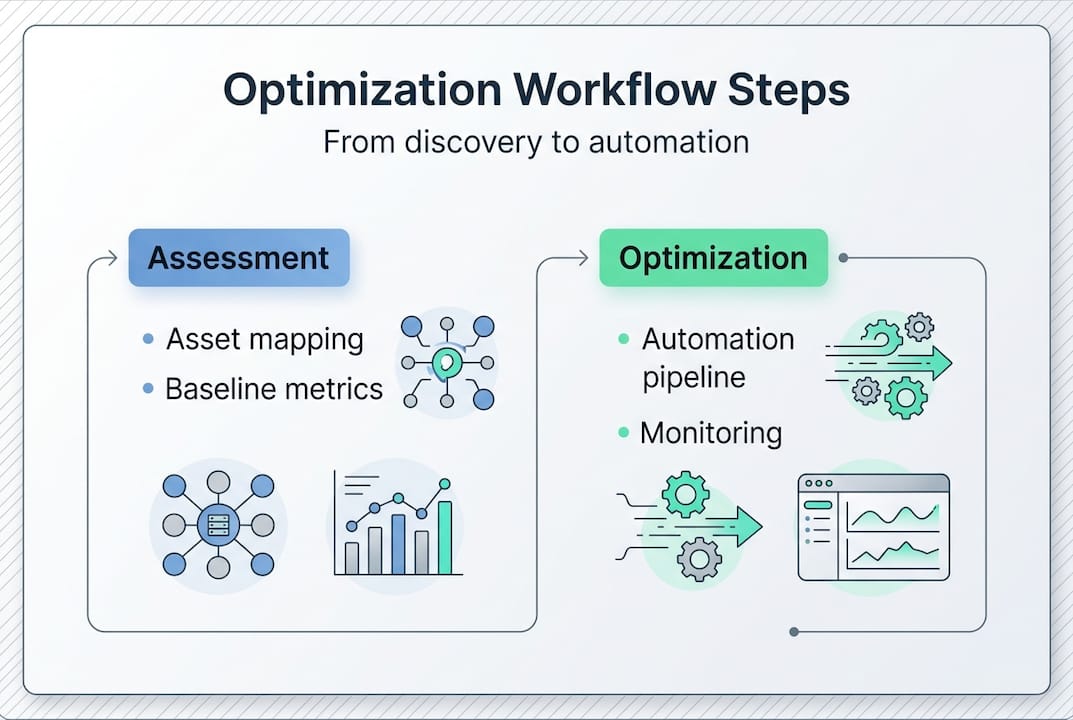
- Audit and baseline. Document current performance metrics, costs, and service levels. Establish a baseline so every future improvement is measurable.
- Rightsizing workloads. Review cloud instance sizes, VM allocations, and server utilization. Downsizing over-provisioned resources is often the fastest win, cutting costs by 20 to 35% in the first cycle.
- Automate provisioning and scaling. Tools like Terraform (infrastructure-as-code) and Ansible (configuration management) eliminate manual provisioning errors and speed up deployment. Automation with tools like Terraform and Ansible delivers real-time optimization and scalability across complex environments.
- Deploy AI-powered monitoring. AIOps platforms, such as Dynatrace or IBM Watson AIOps, correlate events across your stack to predict failures before they cause downtime. This shifts your team from reactive firefighting to proactive management.
- Implement continuous improvement cycles. Use SRE (Site Reliability Engineering) practices to define error budgets and prioritize reliability investments. Review KPIs monthly and adjust automation rules quarterly.
Here's a summary of each phase and what to expect:
| Phase | Key action | Expected outcome |
|---|---|---|
| Audit | Asset mapping, baseline metrics | Full visibility into waste and risk |
| Rightsizing | Resize VMs, consolidate workloads | 20-35% cost reduction |
| Automation | Terraform, Ansible deployment | Faster provisioning, fewer errors |
| Monitoring | AIOps, real-time alerting | Proactive issue resolution |
| Continuous improvement | SRE error budgets, KPI reviews | Sustained performance gains |
For enterprise tips for optimization that go beyond the basics, focus on integrating your automation pipeline with your ITSM platform. This creates a closed loop where incidents trigger automated remediation, not just alerts. AI-driven optimization is rapidly becoming a standard expectation in enterprise IT, not a luxury. You can also explore optimizing business technology approaches to align IT investments with broader business goals.
Pro Tip: Set up error budgets as part of your SRE practice. When a service consumes its error budget, the team pauses new feature work and focuses on reliability. This creates a healthy tension between speed and stability.
Addressing UK compliance, legacy systems, and security pitfalls
After workflow steps, let's address compliance and security, which are key hurdles for UK enterprises.
Cloud sprawl is one of the most common edge cases we see. Teams spin up resources quickly, forget to decommission them, and 30-40% cloud overprovisioning becomes the norm. Brownfield integrations, where new cloud services connect to aging on-premises systems, create unpredictable latency and security gaps. Skill gaps in areas like Kubernetes, Zero Trust architecture, and compliance tooling compound these challenges.
UK enterprises must incorporate GDPR and Cyber Essentials checks into every phase of the optimization workflow, not just at the end. The NCSC's Cyber Essentials guidelines cover five key controls: firewalls, secure configuration, access control, malware protection, and patch management. These are non-negotiable for any enterprise handling personal data or operating in regulated sectors.
"Retrofitting security after deployment invites risk and inefficiency."
Zero Trust is not a product you buy. It's an architecture you build incrementally, starting with identity verification and least-privilege access controls. Begin this work during the audit phase, not after automation is live. For a deeper look at protecting your environment, cybersecurity for UK business outlines the foundational controls every enterprise should have in place. Staying current on cybersecurity trends 2026 also helps you anticipate threats before they reach your infrastructure.
Quick security checks for every workflow phase:
- Audit phase: Verify all assets are covered by your patch management policy
- Rightsizing phase: Confirm decommissioned resources have no lingering access credentials
- Automation phase: Scan Terraform and Ansible scripts for hardcoded secrets
- Monitoring phase: Ensure SIEM (Security Information and Event Management) ingests logs from all new resources
- Continuous improvement: Schedule quarterly Cyber Essentials self-assessments
Legacy system integration deserves special attention. Older systems often lack modern API support, making automation harder. Plan for middleware layers or API gateways to bridge legacy and cloud-native components without exposing sensitive data flows.
Troubleshooting and measuring results: Proving optimization success
With compliance and security addressed, now focus on how to validate and troubleshoot your workflow for continuous improvement.
Building a monitoring dashboard is your first priority after automation goes live. Tools like Grafana, Datadog, or Azure Monitor can consolidate performance data, cost metrics, and compliance status into a single view. This gives you and your leadership team a shared source of truth.
Define your KPIs before you start, not after. The most useful metrics for infrastructure optimization include:
- Cost savings: Monthly cloud spend vs. baseline, cost per workload
- Performance: Average response time, uptime percentage, mean time to recovery (MTTR)
- Compliance status: Percentage of assets meeting Cyber Essentials controls, outstanding patches
- Automation coverage: Percentage of provisioning tasks handled without manual intervention
Integrating ITIL, COBIT, and FinOps enables cost-effective governance and ongoing performance measurement. FinOps (Financial Operations) adds a financial accountability layer to cloud management, ensuring engineering and finance teams share ownership of cloud costs. This ITIL and COBIT integration framework is particularly valuable for enterprises running mixed cloud and on-premises estates.
Common mistakes that derail optimization programs:
- Ignoring legacy bottlenecks until they cause an incident
- Weak governance around who can provision cloud resources
- Siloed monitoring where network, app, and cloud teams use separate tools
- Treating the initial audit as a one-time event rather than a recurring process
- Failing to communicate cost savings to business stakeholders
For troubleshooting, follow this sequence: identify the symptom using your dashboard, isolate the affected component, check recent changes in your automation scripts or configuration management tool, roll back if necessary, and document the root cause. For a practical walkthrough of technology upgrades, upgrading business technology provides a step-by-step guide tailored to UK environments.
A smarter approach: Balancing agility and governance in UK enterprises
Most optimization guides treat ITIL and COBIT as rigid checklists. That's a mistake. Frameworks are tools, not rules, and applying them without judgment creates bureaucracy that slows down the very agility you're trying to build.
The most effective IT teams we've worked with treat governance-as-code, embedding compliance checks directly into their CI/CD pipelines rather than running them as separate audit events. This means security and governance travel with every deployment, not behind it.
Integrating DevOps, FinOps, and AIOps creates a genuinely predictive management model. You're no longer reacting to incidents or budget overruns. You're anticipating them. The UK context adds a layer of complexity here: GDPR obligations, hybrid cloud demands, and a talent market stretched thin across cloud and security skills all require a more sophisticated balance than a simple "adopt the cloud" strategy.
For practical enterprise optimization tips that reflect this integrated thinking, the goal is a living optimization program, not a completed project.
Pro Tip: Treat optimization as a continual process with quarterly review cycles. Infrastructure that was right-sized six months ago may be over-provisioned today as business needs shift.
Leverage expert solutions for seamless IT infrastructure optimization
Implementing a structured optimization workflow takes expertise, tooling, and time that most in-house IT teams are already stretched to provide. The frameworks, automation pipelines, and compliance checks covered in this guide represent months of work when executed without experienced support.
At Mightyskytech.com, we specialize in helping UK enterprises design and execute exactly this kind of end-to-end infrastructure optimization. From initial audits and rightsizing to automation deployment and ongoing compliance monitoring, our team brings the hands-on experience your projects need. We tailor every engagement to your specific environment, whether you're managing a legacy estate, a cloud-first strategy, or a complex hybrid setup. Reach out today to discuss how we can accelerate your optimization program and deliver measurable results.
Frequently asked questions
What is the first step in optimizing IT infrastructure workflow?
Begin with a comprehensive audit to identify strengths, weaknesses, and compliance gaps in your current IT landscape. Established frameworks like ITIL, COBIT, and TOGAF guide systematic audits that surface both technical debt and governance risks.
How do automation tools improve IT infrastructure optimization?
Automation tools like Terraform and Ansible reduce manual workload, enhance scalability, and minimize errors in infrastructure management. Real-time optimization and scalability become achievable at enterprise scale once provisioning is automated.
What UK-specific compliance must be considered?
GDPR and NCSC Cyber Essentials are mandatory frameworks, ensuring secure and legally compliant IT operations in the UK. Cyber Essentials checks and GDPR requirements must be embedded into every phase of your optimization workflow, not treated as an afterthought.
How can IT managers measure the success of optimization?
Success is measured through KPIs such as cost savings, improved performance, and enhanced compliance, monitored via dashboards. Integration of ITIL, COBIT, and FinOps allows for consistent, measurable results across both financial and operational dimensions.