
Most UK business leaders think of IT support as a break-fix function. Something breaks, someone calls the helpdesk, and the problem gets patched. That reactive mindset costs organizations far more than they realize, in downtime, wasted resources, and missed strategic opportunities. IT as reactive is a costly misconception. IT Service Management (ITSM) flips that model entirely, turning technology delivery into a structured, measurable, and business-aligned discipline. This article breaks down what ITSM actually means, which frameworks matter most for UK organizations, what real outcomes look like, and how to build a practical roadmap for getting started.
Table of Contents
- What is IT service management (ITSM)??)
- Core ITSM frameworks and how they differ
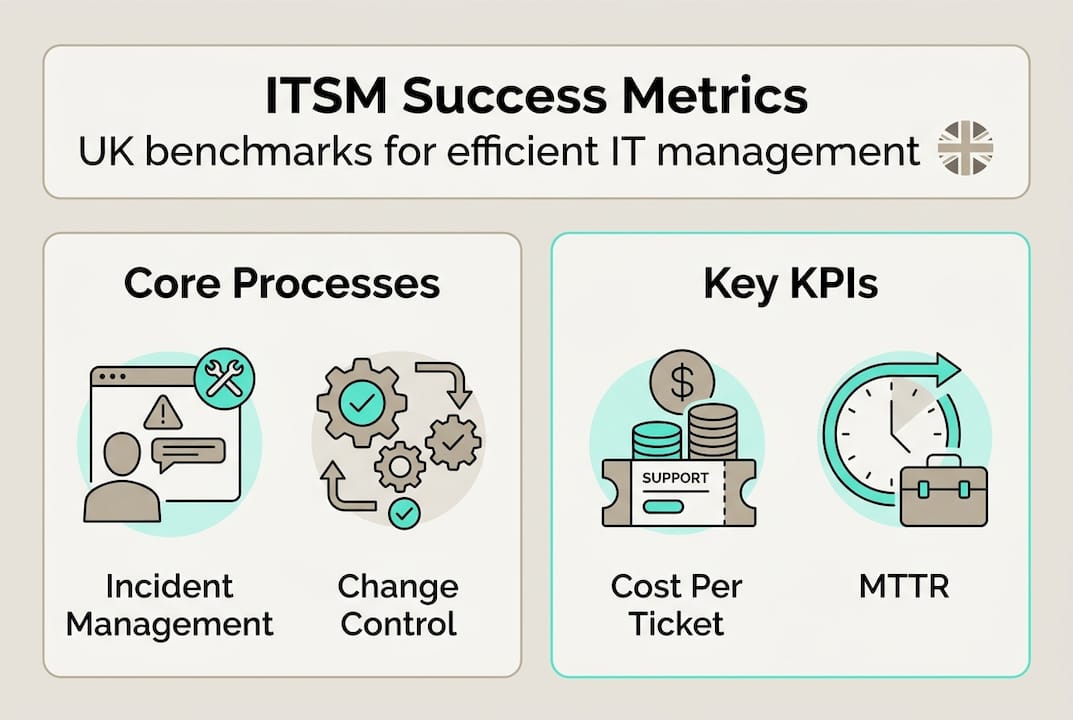
- Key processes and KPIs that drive ITSM success
- Proven ITSM outcomes in UK organizations
- Challenges, pitfalls, and next-gen ITSM trends
- How to get started: Roadmap for UK decision-makers
- Next steps: Expert help for your ITSM journey
- Frequently asked questions
Key Takeaways
| Point | Details |
|---|---|
| ITSM is strategic | ITSM aligns IT services with business goals, transforming IT from a support function to a value driver. |
| Frameworks are tools | Choosing the right ITSM framework depends on your organization's needs and complexity. |
| Measure for improvement | Setting and tracking KPIs drives continual improvement and real business impact. |
| Real gains proven | UK examples show ITSM boosts satisfaction, reduces costs, and accelerates resolutions. |
| Start with assessment | Assessing maturity and processes is essential before rolling out ITSM changes or automations. |
What is IT service management (ITSM)?
ITSM is not a product you buy or a tool you install. It is a way of thinking about and organizing how IT services are designed, delivered, and improved over time. At its core, ITSM is a structured approach to designing, delivering, managing, and improving IT services aligned with business needs, covering processes like incident, problem, change, and service request management.
Think of it like this: without ITSM, your IT team is a fire brigade. With ITSM, they become city planners, preventing fires before they start and building infrastructure that scales.
The key ITSM processes that most organizations rely on include:
- Incident Management: Restoring normal service as quickly as possible after a disruption
- Problem Management: Finding and eliminating the root causes of recurring incidents
- Change Management: Controlling how changes to IT systems are planned and executed
- Service Request Fulfillment: Handling routine requests like software access or hardware setup
- Knowledge Management: Capturing and sharing information to speed up resolution times
- Continual Improvement: Regularly reviewing and refining services based on data and feedback
"ITSM transforms IT from a cost center into a value driver, aligning every service with what the business actually needs to grow."
For organizations that rely on distributed teams or remote workers, remote IT support becomes a critical ITSM component, ensuring service continuity regardless of location.
Pro Tip: Before selecting any ITSM tool or framework, document your current IT processes. You cannot improve what you have not mapped.
Core ITSM frameworks and how they differ
Once you understand what ITSM is, the next question is always: which framework should we use? The answer depends on your organization's size, governance needs, and supplier complexity. Core ITSM frameworks include ITIL, COBIT, ISO/IEC 20000, SIAM, FitSM, and VeriSM, each with a distinct focus.
Here is a quick comparison to help you orient:
| Framework | Primary focus | Best suited for |
|---|---|---|
| ITIL 4 | Service lifecycle and value streams | Most UK enterprises |
| COBIT | IT governance and risk | Regulated industries |
| ISO/IEC 20000 | Certified service management standard | Organizations needing formal accreditation |
| SIAM | Multi-supplier integration | Complex outsourced environments |
| FitSM | Lightweight, practical ITSM | SMEs and less mature organizations |
| VeriSM | Modern, enterprise-wide service management | Digital transformation programs |
A critical distinction: ITSM vs ITIL is not a competition. ITSM refers to the overall practice, while ITIL is one specific framework within it. Many UK organizations default to ITIL simply because it is the most recognized, but that does not always make it the right fit.
For organizations managing complex IT infrastructure tips across multiple vendors, SIAM provides the governance layer needed to coordinate service delivery without chaos. For smaller teams, FitSM offers a practical entry point without the overhead of full ITIL adoption. Understanding the types of IT infrastructure you operate is essential before committing to any framework.
Key questions to ask before choosing a framework:
- How many external suppliers does your IT function rely on?
- Do you need formal certification for regulatory or contractual reasons?
- What is your current process maturity level?
- How much governance overhead can your team realistically sustain?
Key processes and KPIs that drive ITSM success
Choosing a framework is only the beginning. What actually moves the needle is how well you execute the core processes and track the right metrics. Key ITSM processes span incident, problem, change, service request, knowledge, and continual improvement, but world-class execution means measuring each one rigorously.

Here are the benchmarks that matter most for UK IT teams in 2026:
| KPI | Industry benchmark | What it measures |
|---|---|---|
| Cost per ticket | Around £50 typical | Efficiency of service delivery |
| First Contact Resolution (FCR) | 70 to 85% | Quality of frontline support |
| SLA adherence | 94 to 95% | Reliability of service commitments |
| Customer Satisfaction (CSAT) | 90% or above | User experience with IT services |
| MTTR reduction via automation | 26 to 45% improvement | Speed of incident resolution |
| AI call deflection rate | Up to 53% | Automation effectiveness |
These benchmark figures come from real-world ITSM deployments and represent what high-performing organizations achieve.
Here is a practical sequence for building a KPI-driven ITSM operation:
- Baseline your current performance across incident volume, resolution times, and user satisfaction scores
- Set realistic targets based on industry benchmarks, not internal guesswork
- Automate repetitive tasks such as password resets, software provisioning, and ticket routing
- Deploy self-service portals to reduce inbound ticket volume and empower users
- Review KPIs monthly and adjust processes based on what the data shows
For teams focused on optimizing business technology, these metrics provide the evidence base for investment decisions and continuous improvement cycles.
Proven ITSM outcomes in UK organizations
Theory is useful. Real numbers are better. UK public sector organizations have produced some of the most compelling ITSM case studies available, and the results are hard to ignore.
UK councils including Birmingham, Harrow, and Stockport achieved customer satisfaction scores above 90%, first-time fix rates of 60%, and cost savings of £500,000 through structured ITSM adoption and benchmarking programs.
Birmingham City Council stands out as a flagship example. After a full ITSM overhaul using ServiceNow, the council saved over £500,000, achieved 93% CSAT, and deflected 53% of service calls through AI-powered automation. Those are not marginal gains. They represent a fundamental shift in how IT delivers value.
"The organizations that see the biggest ITSM returns are not the ones with the most tools. They are the ones with the clearest processes and the strongest leadership commitment to improvement."
What these case studies share:
- A clear baseline assessment before any technology investment
- Strong leadership sponsorship at the executive level
- Phased implementation rather than a big-bang rollout
- Continuous benchmarking against peer organizations
- Self-service adoption as a core user experience strategy
For organizations pursuing digital workplace transformation, ITSM provides the operational backbone that makes transformation sustainable rather than a one-time project. Pairing ITSM with cloud computing benefits further accelerates the speed and scale of service improvements.
Pro Tip: Benchmark against sector peers, not just internal history. Socitm and HDI publish UK-specific service desk benchmarks that give you an honest external reference point.
Challenges, pitfalls, and next-gen ITSM trends
ITSM is not without its failure modes. Many organizations invest heavily in frameworks and tools, then wonder why outcomes do not improve. The most common pitfalls are predictable and avoidable.
Multi-supplier SIAM environments, AI data-quality risks, and value-stream evolution in ITIL 4 represent the frontier challenges for UK IT leaders right now. Getting these wrong is expensive.
The biggest risks to watch:
- Over-processing: Building so many approval gates and workflows that the system slows down rather than speeds up delivery
- AI without readiness: Deploying AI tools before data quality and process maturity are in place, leading to poor automation outcomes
- Supplier sprawl: Managing multiple vendors without a SIAM layer creates accountability gaps and finger-pointing during incidents
- Framework rigidity: Treating ITIL as a rulebook rather than a guide, which kills the agility that modern IT teams need
AI in ITSM requires maturity models and governance before organizations can realize the deflection and resolution speed gains that vendors promise. Skipping the maturity assessment step is the single most common mistake.
ITIL 4 addresses many of these tensions by shifting focus from rigid processes to value streams, encouraging organizations to blend ITSM with DevOps and Agile practices. This is not about abandoning structure. It is about using just enough structure to enable speed without sacrificing control.
For organizations where cybersecurity in ITSM is a board-level concern, integrating security controls directly into ITSM workflows, rather than treating them as a separate function, is becoming standard practice.
Pro Tip: Run a maturity assessment before any AI or automation investment. Tools amplify what is already there. If your processes are broken, automation just breaks them faster.
How to get started: Roadmap for UK decision-makers
Knowing what ITSM is and seeing what it can achieve is one thing. Building a practical path forward is another. Here is a step-by-step roadmap based on what works in real UK deployments.
Starting with a maturity and process assessment, then setting KPIs and SLAs, automating routine tasks, integrating self-service, and benchmarking regularly is the proven sequence for sustainable ITSM success.
- Conduct a process and maturity assessment to understand where you are today before deciding where to go
- Select a framework that fits your context, whether that is ITIL 4 for a large enterprise or FitSM for a growing SME
- Define your KPIs and SLAs with clear ownership and realistic targets tied to business outcomes
- Pilot automation on high-volume, low-complexity tasks such as password resets and access requests before scaling
- Launch a self-service portal and measure adoption rates alongside ticket deflection
- Review and benchmark quarterly using both internal data and external peer comparisons
- Iterate continuously based on what the data tells you, not what feels comfortable
For organizations making the case internally for digital transformation investment, this roadmap provides a structured argument: start small, prove value, then scale.
Pro Tip: Do not try to implement every ITSM process at once. Pick the two or three that cause the most pain today, fix those first, and build momentum before expanding scope.
Next steps: Expert help for your ITSM journey
Understanding ITSM is the first step. Implementing it effectively, without wasting time on the wrong frameworks or tools, is where specialist guidance pays for itself many times over.
At Mighty Sky Technologies, we work with UK businesses at every stage of the ITSM journey, from initial maturity assessments and framework selection through to automation deployment and continual improvement programs. Whether you are starting from scratch or trying to get more value from an existing ITSM investment, our team brings the practical experience to move you forward without the guesswork. We understand the specific pressures UK IT leaders face, from regulatory requirements to multi-supplier complexity, and we tailor every engagement to your organization's actual context. If you are ready to turn your IT function into a genuine business asset, we are ready to help you build the roadmap.
Frequently asked questions
What's the main difference between ITSM and ITIL?
ITSM is the broad practice of managing IT services across an organization, while ITIL is one specific framework that provides best practice guidance for doing so. You can practice ITSM without using ITIL, though ITIL remains the most widely adopted framework in the UK.
Which ITSM process delivers the fastest gains for UK businesses?
Incident management and self-service adoption consistently deliver the fastest measurable improvements, with UK councils reporting rapid drops in resolution times and significant CSAT boosts within months of implementation.
How does AI impact ITSM?
AI delivered 26 to 45% MTTR reduction and up to 53% call deflection in high-performing deployments, but AI in ITSM requires maturity and strong data governance before those gains are achievable.
Can smaller UK businesses benefit from ITSM?
Absolutely. FitSM provides lightweight ITSM designed specifically for smaller or less mature organizations, allowing them to adopt structured service management without the overhead of a full ITIL implementation.
What steps should a company take to start with ITSM?
Start with a maturity assessment, then select an appropriate framework, define KPIs and SLAs, automate high-volume routine tasks, and benchmark your performance regularly against industry peers.