
TL;DR:
- Cloud computing offers on-demand, scalable resources, transforming UK businesses' agility and cost management.
- UK companies prefer hybrid and multi-cloud models for flexibility, control, and regulatory compliance.
- A strategic, ongoing cloud management approach is essential for realizing benefits and mitigating risks.
Most UK business owners think cloud computing is just a fancier way to store files online. That misunderstanding costs companies real money and missed opportunity. Cloud computing is actually on-demand, configurable access to a shared pool of computing resources, from processing power to entire software platforms, delivered over the internet. For UK businesses navigating digital transformation, that distinction matters enormously. This guide walks you through the core models, deployment options, real risks, and the strategic thinking that separates businesses that thrive in the cloud from those that simply survive it.
Table of Contents
- Defining cloud computing: The fundamentals
- Exploring cloud service models: IaaS, PaaS, SaaS
- Deployment models: Public, private, hybrid, and multi-cloud
- Risks, challenges, and strategic considerations for UK businesses
- The expert view: Why a tailored cloud strategy beats simple adoption
- Take the next step with cloud solutions for your business
- Frequently asked questions
Key Takeaways
| Point | Details |
|---|---|
| Cloud computing defined | Cloud computing means on-demand access to shared computing resources with minimal management. |
| Key models and options | UK businesses choose among IaaS, PaaS, SaaS and public, private, hybrid, or multi-cloud for flexibility and control. |
| Strategic risks exist | Risks include vendor lock-in, data sovereignty, hidden costs, and compliance challenges especially in the public cloud. |
| Hybrid/multi-cloud trends | Most UK enterprises now use hybrid or multi-cloud deployments to align with compliance and operational needs. |
| Tailored strategy is key | A customized, regularly updated cloud strategy delivers greater benefits than simple adoption alone. |
Defining cloud computing: The fundamentals
Cloud computing is not a product. It is a delivery model. According to the NIST SP 800-145 standard, cloud computing offers convenient, on-demand access to a shared pool of configurable resources, including networks, servers, storage, applications, and services, that can be rapidly provisioned and released with minimal management effort.
For a UK business owner, that translates to something practical: you stop buying expensive hardware and start paying for computing capacity the way you pay for electricity. Use more, pay more. Use less, pay less. That shift alone changes how companies budget for technology.
The five core characteristics that define genuine cloud computing are:
- On-demand self-service: Provision computing resources without requiring human interaction from the provider.
- Broad network access: Access resources from any device, anywhere, over standard internet connections.
- Resource pooling: Providers serve multiple customers from shared infrastructure, dynamically allocating capacity.
- Rapid elasticity: Scale resources up or down almost instantly based on demand.
- Measured service: Usage is monitored, controlled, and billed transparently.
"The real power of cloud is not in replacing your server room. It is in giving your business the ability to move at the speed of opportunity rather than the speed of procurement."
For UK businesses, this matters because cloud's role in business transformation goes far beyond cost savings. It enables faster product launches, better remote collaboration, and access to enterprise-grade tools that were once reserved for large corporations with large budgets. A 20-person firm in Manchester can now run the same analytics infrastructure as a FTSE 100 company, without owning a single physical server.
The components involved span virtual servers, databases, networking tools, developer environments, AI services, and complete software applications. Understanding this breadth is the first step toward choosing the right approach for your organization.
Exploring cloud service models: IaaS, PaaS, SaaS
Once you understand what cloud computing is, the next question is: which version of it do you actually need? The core service models are Infrastructure-as-a-Service (IaaS), Platform-as-a-Service (PaaS), and Software-as-a-Service (SaaS), and each one places a different level of management responsibility on your team.
Here is a straightforward comparison:
| Model | What the provider manages | What you manage | Best for |
|---|---|---|---|
| IaaS | Physical hardware, networking | OS, middleware, apps, data | IT teams needing full control |
| PaaS | Hardware, OS, runtime | Applications, data | Developers building custom tools |
| SaaS | Everything | Configuration, user access | Most business users |
Think of it this way:
- IaaS is like renting an empty office space. You bring your own furniture, set up your own systems, and manage everything inside. A UK logistics company might use IaaS to run custom warehouse management software on virtual machines.
- PaaS is like renting a furnished office with shared reception. The basics are handled, and you focus on your work. A fintech startup might use PaaS to build and deploy a customer-facing application without managing the underlying infrastructure.
- SaaS is like using a co-working space where everything is provided. You just show up and work. HR platforms like Workday or productivity suites like Microsoft 365 are classic SaaS examples used widely across UK businesses.
The shared responsibility model is critical for compliance. In SaaS, the provider handles most security. In IaaS, your team carries far more of that burden. Many UK businesses underestimate this when moving to the cloud, which creates gaps in their security posture.
Pro Tip: Before selecting a model, map out which applications your team actually uses daily. Most businesses find they need a mix: SaaS for productivity and HR, PaaS for custom development, and IaaS for specific workloads requiring fine-grained control. Exploring cloud options for enterprises can help you align each model with your operational goals.
Deployment models: Public, private, hybrid, and multi-cloud
Service models describe what you get. Deployment models describe where and how it runs. This distinction shapes everything from your monthly bill to your regulatory compliance posture.
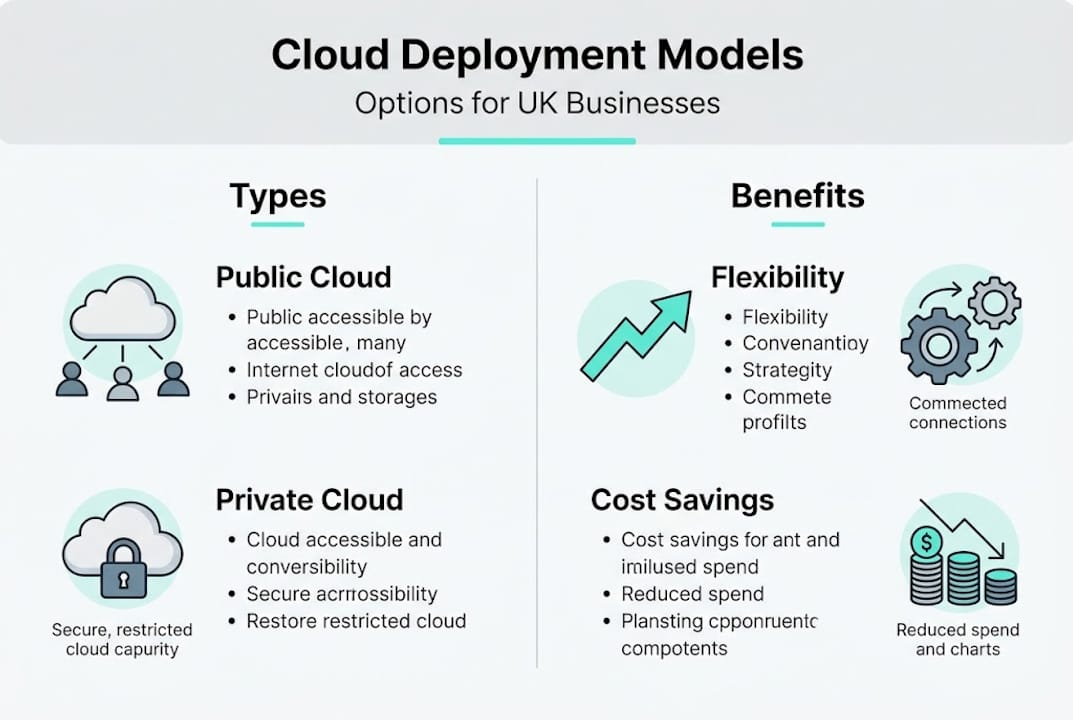
Public cloud means resources are hosted by a third-party provider like AWS, Microsoft Azure, or Google Cloud, and shared across many customers. It is cost-effective and scalable, but you have less control over where your data physically sits.

Private cloud means infrastructure is dedicated solely to your organization, either on-premises or hosted by a provider. You get more control and isolation, but at a higher cost.
Hybrid cloud combines public and private environments, letting you run sensitive workloads privately while leveraging public cloud for scale or cost efficiency.
Multi-cloud means using services from multiple public cloud providers simultaneously, reducing dependence on any single vendor.
UK adoption trends are telling. A 70-90% majority of UK firms favor hybrid or multi-cloud strategies for flexibility and compliance. That is not a coincidence. UK-specific regulations around data residency, combined with the complexity of post-Brexit data transfer rules, make pure public cloud a risky default for many sectors.
Here is a quick breakdown of each model's trade-offs:
| Deployment | Cost | Control | Compliance fit | Flexibility |
|---|---|---|---|---|
| Public | Low | Low | Moderate | High |
| Private | High | High | High | Low |
| Hybrid | Medium | Medium-High | High | High |
| Multi-cloud | Medium | Medium | High | Very High |
For most UK businesses, infrastructure strategies for hybrid cloud represent the most pragmatic path forward. You keep sensitive customer data on a private environment while using public cloud for collaboration tools or burst computing. Properly managing IT infrastructure across these environments requires clear governance from day one.
Risks, challenges, and strategic considerations for UK businesses
Cloud computing delivers real advantages, but it also introduces risks that are easy to underestimate when you are focused on the benefits. UK business leaders evaluating cloud investments need to look at these challenges with clear eyes.
The most pressing risks include:
- Vendor lock-in: Migrating workloads away from a major provider can be technically complex and expensive. Contracts often favor the vendor.
- Data sovereignty: The US CLOUD Act means US-based providers can be compelled to hand over data stored anywhere in the world, including UK data centers. This is a genuine legal exposure for regulated industries.
- Cost overruns: Cloud bills are notoriously difficult to predict. Without active management, costs can spiral as teams spin up resources without oversight.
- Compliance gaps: UK GDPR, FCA regulations, and sector-specific rules create obligations that generic cloud configurations may not automatically satisfy.
- Service outages: Even major providers experience downtime, and your business continuity plan needs to account for that reality.
As vendor lock-in, data sovereignty, cost overruns, and regulatory changes continue to challenge UK cloud adopters, the industry has shifted from a "cloud-first" mindset to a more nuanced "cloud-smart" approach. That means choosing cloud when it genuinely fits, not because it is the default.
"Cloud-smart is not a retreat from cloud adoption. It is a recognition that the goal is business outcomes, not technology adoption for its own sake."
Strategically, UK businesses should prioritize three practices. First, implement FinOps, a financial operations discipline that brings engineering, finance, and business teams together to manage cloud spend proactively. Second, conduct a data residency assessment before signing any provider contract. Third, negotiate exit clauses and data portability terms upfront, not after you are already dependent on a platform.
Pro Tip: Treat your cloud provider relationship like any major vendor relationship. Review contracts annually, benchmark pricing against competitors, and never let a single provider become impossible to replace. Strong cybersecurity for cloud infrastructure and attention to cloud efficiency and security best practices are non-negotiable parts of this process. Staying current on cloud security trends helps you anticipate threats before they become incidents.
The expert view: Why a tailored cloud strategy beats simple adoption
Here is what most cloud articles will not tell you: simply moving to the cloud is not a strategy. It is a starting point. We have seen UK organizations invest heavily in cloud migration, only to find themselves paying more than before while struggling with complexity they did not anticipate.
The businesses that genuinely benefit treat cloud as a living strategy, not a one-time project. They revisit their architecture quarterly, retrain staff as tools evolve, and actively measure whether each workload belongs in the cloud or somewhere else. Hybrid and multi-cloud strategies are critical to avoid lock-in and maintain compliance under UK and international regulations, but only when implemented with clear governance.
The uncomfortable truth is that most organizations underestimate ongoing optimization. Migration gets the budget. Optimization rarely does. That imbalance is where competitive advantage is lost. Staying ahead of business technology trends for 2026 means treating cloud as a strategic capability, not just an IT decision.
Take the next step with cloud solutions for your business
Understanding cloud computing is one thing. Building a strategy that actually works for your business, your regulatory environment, and your budget is another challenge entirely. The gap between knowing the models and executing them well is where most UK businesses need support.
At Mightyskytech, we work with UK businesses to design and implement cloud strategies that are tailored to their specific operational and compliance needs. Whether you are evaluating your first cloud migration or optimizing an existing multi-cloud environment, our team brings the technical depth and business understanding to help you move forward with confidence. Reach out to explore how a structured cloud assessment can clarify your next steps.
Frequently asked questions
What are the main benefits of cloud computing for UK businesses?
Cloud delivers operational efficiency via scalability and pay-per-use pricing, meaning businesses only pay for what they consume and can scale resources rapidly as demand changes.
What are common risks of using public cloud services?
Vendor lock-in, data sovereignty, cost overruns, and regulation concerns are the top challenges, particularly for UK businesses operating in regulated industries like finance or healthcare.
How is data controlled and secured in cloud solutions?
Control is shared between provider and client depending on the service model; hybrid models are favored by UK organizations that need stronger data residency controls and regulatory compliance.
How do I choose between public, private, and hybrid cloud?
A 70-90% majority of UK firms favor hybrid or multi-cloud because it balances cost efficiency with the compliance and control requirements that UK regulations demand.