
Unmanaged IT is a silent budget drain. When systems fail without a structured response plan, productivity stalls, staff frustration spikes, and recovery costs spiral fast. Downtime can cost UK businesses up to £11,000 per minute, making reactive break-fix models a serious financial liability. This guide walks you through every phase of the managed IT support process, from understanding its core value to measuring outcomes. Whether you are evaluating your first managed service provider (MSP) or refining an existing partnership, you will leave with a clear, actionable framework built for UK enterprise realities.
Table of Contents
- Understanding managed IT support and its value
- Preparing for managed IT support: prerequisites and requirements
- Step-by-step: The managed IT support process
- Troubleshooting, edge cases and common mistakes
- Verifying outcomes: Measuring success and continuous improvement
- Next steps: Unlock expert managed IT support for your business
- Frequently asked questions
Key Takeaways
| Point | Details |
|---|---|
| Structured IT support | A well-defined managed IT support process reduces downtime, risk and total cost. |
| ITIL and certifications | Choosing MSPs with ITIL frameworks and Cyber Essentials certification ensures reliable, scalable solutions. |
| Hybrid solutions work | Hybrid/co-managed models help maintain visibility and control as your business scales. |
| Preparation matters | Documented workflows, endpoint inventory and clear SLAs are key prerequisites for success. |
| Continuous improvement | Ongoing root-cause analysis and performance reviews optimize your IT environment in the long term. |
Understanding managed IT support and its value
Managed IT support is a proactive model where an external provider takes ongoing responsibility for your IT environment under a defined service level agreement (SLA). Unlike break-fix, where you call someone only when something breaks, managed support means your systems are monitored, maintained, and optimized continuously.
The methodology behind it is structured. Managed IT support follows a methodology including Discovery, Design, Deployment, and Continuous Improvement, often aligned with ITIL frameworks. ITIL, which stands for Information Technology Infrastructure Library, provides standardized processes for incident management, problem management, and change management. These processes ensure that issues are logged, escalated, and resolved consistently rather than handled ad hoc.
Businesses today are not limited to a binary choice between fully outsourced and fully in-house IT. Hybrid MSP models are on the rise for better scalability and control, allowing internal teams to retain ownership of sensitive systems while MSPs handle monitoring, patching, and helpdesk functions.
For business leaders, the value is tangible:
- Predictable monthly costs replace unpredictable emergency repair bills
- Faster incident resolution through defined escalation paths
- Scalability as your workforce or infrastructure grows
- Compliance support aligned with UK regulatory requirements
- Access to specialist expertise without full-time hiring costs
Understanding IT service management in the UK is the foundation for making smart MSP decisions. When choosing a managed service provider, the NCSC recommends evaluating security practices, contractual clarity, and supply chain risk as primary criteria.
"The right MSP is not just a vendor. It is a strategic partner that understands your risk profile, your growth trajectory, and your compliance obligations." This distinction separates high-performing IT partnerships from costly disappointments.
Preparing for managed IT support: prerequisites and requirements
Before you sign a contract with any provider, your organization needs to be ready. Jumping into a managed IT engagement without preparation leads to scope creep, miscommunication, and poor outcomes.
Here is what you need in place:
- A complete network inventory covering all hardware, software, and cloud assets
- Documented workflows for critical business processes
- Defined SLAs that reflect your actual business needs, not just vendor defaults
- Cyber Essentials certification or a clear plan to achieve it
- Least privilege access policies to limit exposure during onboarding
- Endpoint visibility across all devices, including remote and mobile
Certifications like Cyber Essentials and clear SLAs are vital for UK businesses engaging MSPs. Without them, you hand over control without the governance structure to protect it. Separately, 31% of companies delay upgrades due to inadequate capacity and planning, which means entering an MSP relationship with legacy gaps already in place.
| Requirement | In-house IT | MSP | Hybrid |
|---|---|---|---|
| Network inventory | Internal team | MSP-led audit | Shared responsibility |
| SLA definition | Internal policy | Vendor template | Negotiated jointly |
| Cyber Essentials | Self-managed | MSP-assisted | Co-managed |
| Endpoint visibility | Full control | MSP tools | Shared tooling |
| Workflow documentation | Internal | Onboarding requirement | Pre-engagement task |
Strong cybersecurity for UK business starts before the MSP engagement begins. Treat your preparation phase as a security audit, not just an administrative checklist.
Pro Tip: Avoid tool sprawl from day one. Before onboarding, audit every monitoring, ticketing, and security tool your team currently uses. Consolidate where possible. Bringing a bloated toolset into a managed engagement creates alert fatigue and slows response times significantly.
Step-by-step: The managed IT support process
With your prerequisites in place, you are ready to execute. Here is how the process unfolds across its core phases.
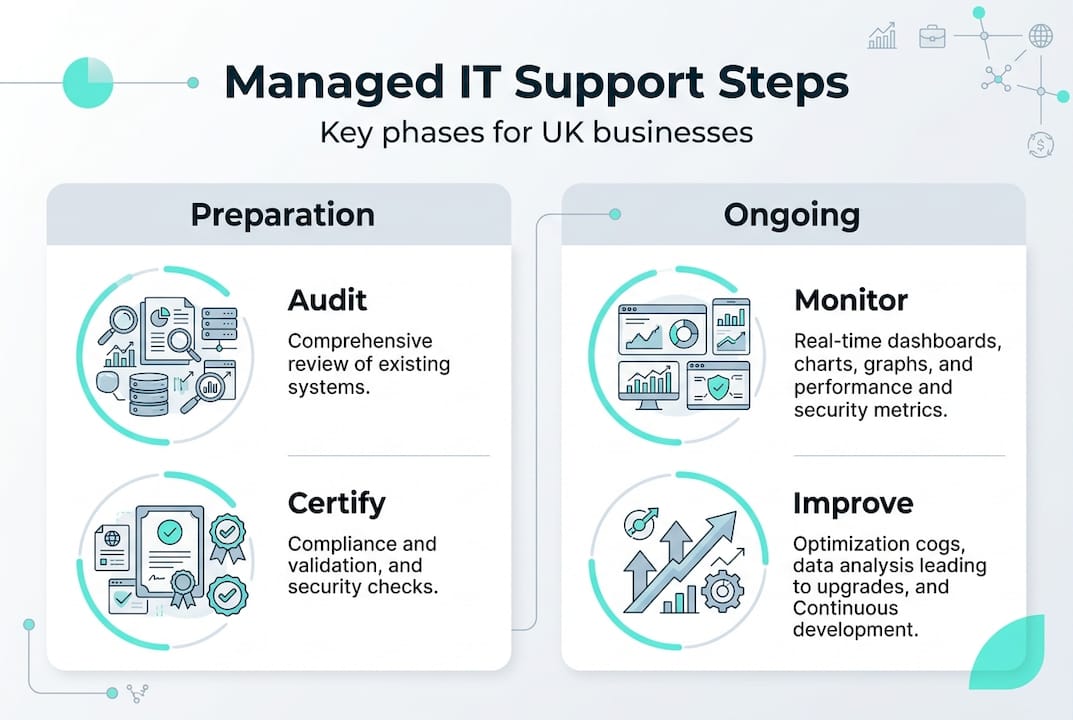
- Discovery and alignment — The MSP audits your current environment, maps dependencies, identifies gaps, and aligns on business objectives and risk tolerance.
- Gap assessment — Vulnerabilities, outdated systems, and compliance shortfalls are documented and prioritized.
- Solution design — The MSP proposes a tailored architecture covering monitoring, security, backup, and helpdesk coverage.
- Deployment — Tools are installed, integrations are configured, and staff are onboarded to new workflows.
- Baseline monitoring — The MSP establishes performance baselines and begins proactive alerting.
- Incident response activation — Incident management follows a 10-step process; problem management addresses root causes and known errors to prevent recurrence.
- Change management — All changes to the environment follow a structured approval and testing process to minimize disruption.
- Continuous improvement — Regular reviews refine processes, update documentation, and adjust SLAs based on performance data.
Continuous improvement and root-cause analysis reduce disruptions by 40%, making this phase one of the highest-value investments in the entire process.
| Phase | Key actions | Responsible party | Expected outcome |
|---|---|---|---|
| Discovery | Audit, gap analysis | MSP + IT lead | Full environment map |
| Design | Architecture planning | MSP | Approved solution blueprint |
| Deployment | Tool setup, integration | MSP | Live monitoring environment |
| Monitoring | Alerting, reporting | MSP | Proactive issue detection |
| Improvement | Reviews, SLA updates | MSP + leadership | Reduced incidents over time |
For deeper guidance on building a resilient foundation, review these IT infrastructure tips and the full business technology upgrade guide for UK organizations.
Understanding the ITIL problem management process helps your team collaborate more effectively with your MSP during root-cause investigations.
Pro Tip: During change management, require your MSP to submit a change advisory board (CAB) record for every significant update. This creates an audit trail, reduces unauthorized changes, and gives your leadership team full visibility into what is being modified and why.
Troubleshooting, edge cases and common mistakes
Even the best processes encounter friction. Knowing where things typically go wrong lets you get ahead of problems before they escalate.
Edge cases include tool sprawl, endpoint growth, alert fatigue, and supply chain risks. Co-managed and hybrid models help mitigate visibility loss when these challenges arise. Here is how to address each one:
- Tool sprawl: Consolidate monitoring and ticketing platforms during onboarding. Limit the number of vendors with access to your environment.
- Unmanaged endpoints: Enforce a device registration policy before go-live. Every endpoint, including personal devices used for work, must be visible to your MSP.
- Alert fatigue: Work with your MSP to tune alert thresholds. Not every low-priority event needs a ticket. Define severity tiers clearly in your SLA.
- Supply chain risks: Vet your MSP's own vendor relationships. A breach in their toolchain can become your breach.
- Visibility gaps: In hybrid models, define exactly which systems the MSP can access and which remain internal. Ambiguity here creates security blind spots.
Reviewing the types of IT infrastructure your organization relies on helps you map visibility requirements before engagement.
"Co-managed IT support is not a compromise. It is a deliberate strategy that keeps your internal team in control of business-critical systems while leveraging MSP expertise for scale and speed."
Verifying outcomes: Measuring success and continuous improvement
Signing a contract is not the finish line. Measuring performance is what separates organizations that get real value from their MSP from those that simply pay monthly fees without accountability.
Start with these success metrics:
- Mean time to resolution (MTTR): How quickly are incidents resolved after detection?
- Uptime percentage: Are you hitting the availability targets defined in your SLA?
- Incident volume trends: Is the number of recurring incidents decreasing over time?
- Cost per incident: Are you spending less per issue compared to your previous model?
- User satisfaction scores: Are your staff experiencing fewer disruptions and faster support?
- Security posture improvements: Are vulnerability counts and patch compliance rates improving?
Proactive monitoring and root-cause analysis reduce risks and disruptions, which is essential for infrastructure and security enhancement. Schedule quarterly business reviews (QBRs) with your MSP to walk through these metrics together and adjust priorities.
UK businesses should focus on total cost including downtime prevention for true value. A provider that costs slightly more per month but eliminates three major outages per year delivers far greater return than a cheaper alternative that reacts slowly.
Pro Tip: Use your QBR data to drive your digital transformation roadmap. Your MSP sees patterns across your entire environment. Ask them directly: where are the bottlenecks limiting your growth? Their answer should shape your next 12 months of investment.
Exploring cloud computing for transformation and optimizing business technology are natural next steps once your managed IT foundation is stable and performing.
Next steps: Unlock expert managed IT support for your business
You now have a complete picture of the managed IT support process, from preparation through continuous improvement. The next step is finding a partner who can execute it with precision.

Mighty Sky Technologies delivers ITIL-aligned managed IT support built specifically for UK enterprises. Whether you need full outsourcing, a hybrid co-managed model, or targeted support for security and infrastructure, the team brings the expertise to match your exact requirements. From initial discovery through ongoing optimization, every engagement is tailored to your business objectives, not a generic template. Explore the full remote IT support guide to understand how remote-first delivery models can extend your support coverage without adding headcount. Contact Mighty Sky Technologies today to schedule your managed IT consultation.
Frequently asked questions
What is the main benefit of managed IT support over traditional break-fix services?
Managed IT support delivers proactive monitoring and faster issue resolution, significantly lowering downtime and cost. Break-fix downtime can cost UK businesses over £11,000 per minute, making reactive models far more expensive in the long run.
How do ITIL processes shape the managed IT support workflow?
ITIL provides a structured framework for incident, problem, and change management, which most MSPs follow to ensure consistent, reliable support. ITIL is core to how incidents are logged, escalated, and resolved across the entire support lifecycle.
What should UK businesses look for when selecting a managed IT service provider?
Prioritize providers with ITIL expertise, Cyber Essentials certification, clear SLAs, and flexible hybrid models. Cyber Essentials and clear SLAs are vital for UK businesses to maintain governance and security during an MSP engagement.
How is managed IT support priced in the UK?
Typical costs range from £30 to £120 per user per month depending on monitoring scope and add-ons. Managed IT support costs average £30 to £80 per user per month, with break-fix models costing significantly more when downtime losses are factored in.
Why are hybrid or co-managed IT support models growing in popularity?
Hybrid and co-managed approaches balance business control with external expertise, helping organizations address tool sprawl and rapid growth without losing visibility. Traditional MSPs are shifting to co-managed and hybrid models to better serve scaling businesses.