
TL;DR:
- Many UK enterprises fail digital transformations due to lack of clear, well-structured IT strategy.
- A strong IT strategy aligns technology investments with measurable business goals and emphasizes governance, data, and culture.
- Successful transformation relies on organizational buy-in, clear goals, phased rollout, and continuous measurement.
Adopting new technology without a clear plan is like building a skyscraper without blueprints. Yet that is precisely what many UK enterprises do, and the consequences are severe. 70% of digital transformations fail, with UK firms losing an estimated £27 million for every £100 million invested. The hard truth is that technology alone does not drive transformation. The missing ingredient, more often than not, is a disciplined, well-structured IT strategy. This guide breaks down exactly what IT strategy means for medium and large enterprises, what it delivers in measurable terms, and how to build one that actually works.
Table of Contents
- What is IT strategy and why does it matter?
- The business impact: What a strong IT strategy delivers
- Why transformation projects fail: Lessons from the field
- How to build and implement a winning IT strategy
- A fresh perspective: What most IT strategies miss (and how to stand out)
- Connect technology strategy with business results
- Frequently asked questions
Key Takeaways
| Point | Details |
|---|---|
| Strategy failure costs | Most transformation failures are rooted in weak or misaligned IT strategy and can cost millions. |
| Data-driven advantage | Enterprises that prioritize advanced data practices and phased implementation see lasting productivity gains. |
| Avoid common pitfalls | Lack of governance, clarity, and employee involvement are top reasons for failed IT projects. |
| Make strategy actionable | Build IT plans around measurable business value, skills, and continuous improvement. |
What is IT strategy and why does it matter?
IT strategy is not a shopping list of software tools or a plan to upgrade servers. It is the deliberate alignment of your technology decisions with your organization's core business goals. For large UK enterprises, this means connecting every tech investment, from cloud migration to cybersecurity, back to a specific, measurable business outcome.
A mature IT strategy rests on five key pillars:
- Data: Understanding what data you have, where it lives, and how it drives decisions
- Processes: Mapping how technology changes the way work gets done
- Governance: Setting clear rules for who owns technology decisions and how risks are managed
- Culture: Ensuring your people are ready, willing, and able to work differently
- Emerging technologies: Identifying which innovations are relevant to your sector and growth plans
Think of IT strategy as the connective tissue between your C-suite ambitions and your IT team's daily work. Without it, even well-funded initiatives drift. Teams invest in platforms that do not talk to each other. Projects launch without clear success criteria. Momentum stalls.
"A strategy without governance is just a wish list. The organizations that succeed treat IT planning as a continuous leadership responsibility, not a one-time document."
UK government research confirms that data maturity and governance are critical enablers of transformation success for enterprises. Prioritizing phased implementation alongside strong governance structures significantly improves outcomes.
For organizations just beginning to see why structure matters, exploring digital transformation for efficiency is a natural starting point. Those already partway through the journey will benefit from reviewing IT management strategies built specifically for UK business contexts in 2026.
The bottom line: IT strategy is not an IT department document. It is a board-level conversation with technical execution behind it.
The business impact: What a strong IT strategy delivers
Understanding IT strategy is one thing, but what does it actually deliver when executed well? Let's look at the impact with real numbers.
The evidence for investing in structured IT strategy is compelling. UK government data shows that data-active firms are more productive, and larger organizations that systematically share and analyze data consistently outperform their less data-mature counterparts. This is not a marginal effect. We are talking about meaningful differences in output per employee and cost efficiency across sectors.
Here is what a strong IT strategy typically delivers across key performance areas:
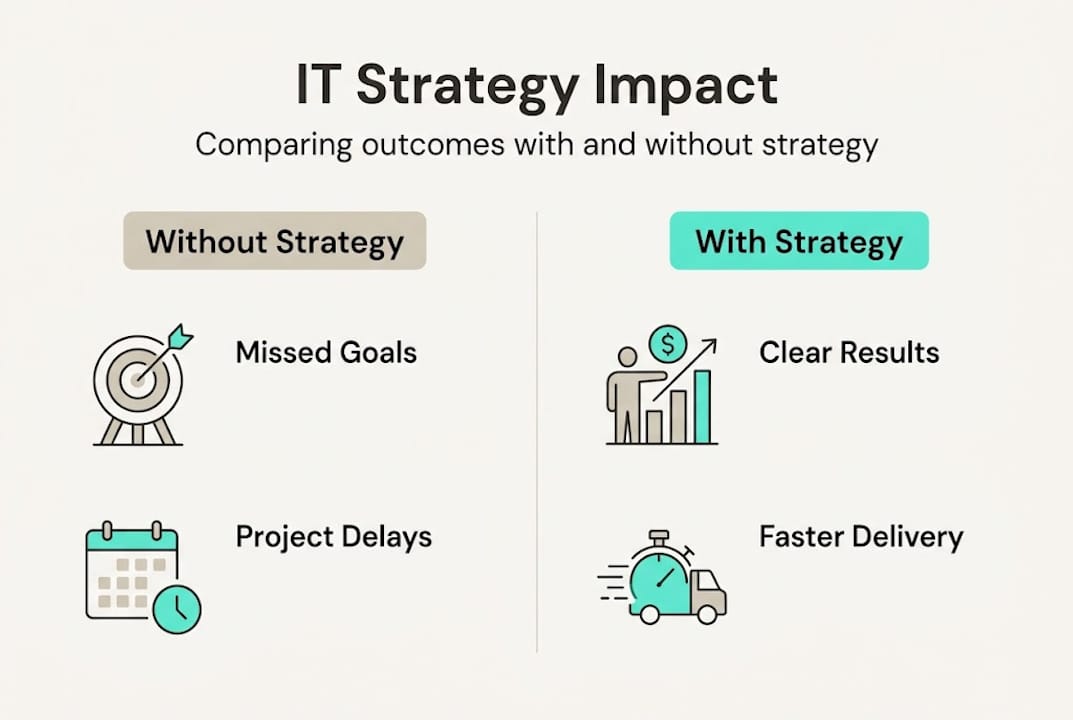
| Business area | Without IT strategy | With IT strategy |
|---|---|---|
| Project delivery | Frequent overruns | On-time, phased milestones |
| Data use | Siloed and reactive | Integrated and predictive |
| Cost control | Unplanned spend spikes | Predictable, governed budgets |
| Employee adoption | Low engagement, high friction | Structured onboarding and training |
| Risk management | Ad hoc, reactive | Proactive, policy-driven |
Enterprises that treat IT strategy as a living plan, revisited quarterly, see faster pivots when market conditions change. Those that treat it as a fixed annual report find themselves reacting to problems rather than anticipating them.

Pro Tip: Tie every technology initiative in your roadmap to at least one KPI your board already cares about. If you cannot make that connection, the project needs more scrutiny before approval.
For practical frameworks you can apply immediately, the proven transformation strategies developed for UK enterprises offer a useful reference point. Organizations looking to improve workforce output specifically should explore how to boost enterprise productivity through digital workplace design.
The pattern across high-performing enterprises is consistent. Strategy first, technology second. Measure constantly. Adjust often.
Why transformation projects fail: Lessons from the field
Of course, not every IT initiative succeeds. To understand why, let's break down the most common causes of failure and what to avoid.
One in three transformation projects sees no return on investment at all. For UK enterprises spending hundreds of millions on modernization, that statistic should be alarming. The causes are rarely technical. They are strategic.
The most common failure patterns fall into three categories:
- Unclear goals: Projects launched without a defined outcome, owner, or success metric
- Poor data maturity: Transformation built on unreliable, incomplete, or siloed data
- Weak governance: Decisions made inconsistently across departments, with no central oversight
Beyond these three, two additional red flags appear consistently in post-mortems of failed programs:
- Ignoring employee adoption: Tools deployed without training or behavioral change support fail at the user level, even when they are technically sound
- Skipping phased rollout: Attempting enterprise-wide deployment in a single wave dramatically increases risk
"The organizations that fail fastest are the ones that treated transformation as a technology problem. The ones that succeed treated it as a people, process, and governance challenge that technology happened to support."
Here is how successful versus struggling transformation programs typically compare:
| Factor | Struggling programs | Successful programs |
|---|---|---|
| Goal clarity | Vague or shifting objectives | Defined KPIs from day one |
| Leadership alignment | IT-led in isolation | C-suite ownership and sponsorship |
| Change management | Minimal employee engagement | Structured adoption programs |
| Phasing | Big-bang deployment | Iterative, milestone-driven rollout |
| Governance | Reactive and fragmented | Proactive and centralized |
Studying UK transformation case studies across industries reveals a consistent truth. The variables that separate winners from losers are almost always organizational, not technical.
How to build and implement a winning IT strategy
Learning from past missteps, here's how to formulate an IT strategy that drives measurable results.
Building a winning IT strategy is not a one-day workshop exercise. It is a structured process that requires honest assessment, cross-functional alignment, and disciplined execution. Here is a proven sequence:
- Assess your current state honestly. Map your data maturity, infrastructure gaps, and process inefficiencies before setting targets. You cannot plot a route without knowing your starting point.
- Align with enterprise goals. Every technology priority should trace directly back to a strategic business objective. Revenue growth, cost reduction, regulatory compliance, customer experience. Pick your anchors.
- Segment your roadmap. Separate quick wins (deliverable within 90 days) from medium-term projects (six to twelve months) and long-term transformation (twelve to thirty-six months). This keeps momentum high while managing risk.
- Build governance into the design. Assign ownership for every workstream. Define escalation paths. Establish a steering group with real authority, not just advisory status.
- Invest in training and change management. Research confirms that phased implementation with governance increases productivity. Training is not a cost. It is a multiplier on every technology investment you make.
- Measure and iterate. Set review checkpoints at thirty, sixty, and ninety days. Use real performance data to adjust priorities. A strategy that cannot adapt is already obsolete.
Pro Tip: Build your IT strategy roadmap in two layers: a board-facing version with business outcomes and financial impact, and a technical execution version for your IT teams. Both are necessary. Conflating them creates confusion.
For infrastructure-specific guidance, IT infrastructure tips for enterprise success in 2026 provide a solid operational framework. Organizations focused on getting the most from existing investments should review approaches to optimizing business technology before committing to new spend.
A fresh perspective: What most IT strategies miss (and how to stand out)
After outlining best practices, let's go a level deeper and explore what even well-informed strategies often overlook.
Here is an uncomfortable observation we have made working with enterprises across the UK. Most IT strategy failures are not caused by poor planning documents. They are caused by invisible organizational dynamics that no planning template ever captures.
Leadership alignment is the first blind spot. A strategy that the CIO champions but the CFO quietly resists will stall in budget discussions. One that IT drives without genuine CEO sponsorship gets deprioritized the moment a commercial crisis appears. Real alignment means every executive has skin in the game.
Cultural readiness is the second. Technology changes how people work. If your organization has a low tolerance for ambiguity or a history of punishing failure, even well-designed transformation programs will face passive resistance. You cannot solve a culture problem with a software license.
Finally, most strategies treat IT upskilling as an afterthought. Continuous learning needs to be structured into the operating model, not bolted on at go-live. The technology trends shaping transformation are moving fast enough in 2026 that a workforce trained twelve months ago may already be behind.
Treat your IT strategy as a living system, not a fixed plan. The organizations pulling ahead are the ones that build adaptability into the strategy itself.
Connect technology strategy with business results
To truly move forward, sometimes expert insight or partnership is what takes a strategy from good to great.
At MightySkyTech, we work with medium and large UK enterprises to turn strategy intent into measurable outcomes. Whether you are just beginning to structure your roadmap or trying to recover a stalled transformation program, our team brings hands-on experience across IT consultancy, cloud, cybersecurity, and managed services.

Exploring how technology drives UK business growth is a useful next step if you are building a business case for your leadership team. If you are ready to accelerate and want a partner who understands the stakes, get in touch with us to discuss how we can support your transformation goals with practical, enterprise-grade expertise.
Frequently asked questions
What are the biggest risks of not having a formal IT strategy?
Without a formal IT strategy, UK enterprises face high failure rates and significant value destruction, with transformation projects routinely delivering no measurable return on investment.
How often should enterprises update their IT strategy?
IT strategy should be reviewed at minimum annually and revisited whenever significant business events occur, such as mergers, regulatory changes, or major shifts in market conditions.
What is the difference between IT strategy and digital transformation?
IT strategy sets the governance, priorities, and roadmap for technology investment, while digital transformation is the execution enabled by that strategy to drive efficiency and business outcomes.
Which UK industries benefit most from advanced IT strategy?
Data-centric sectors such as finance, retail, and manufacturing see the largest productivity gains, as data-active firms in these sectors are significantly more likely to analyze and share data at scale.
Recommended
- Business technology trends driving transformation in 2026
- 7 Proven Digital Transformation Strategies for UK Enterprises
- How technology drives UK business growth: £317B impact
- Cloud computing's role in UK business transformation
- IT Teams | Outsprinter
- Role of software teams in scaling: a 2026 guide for CTOs