
TL;DR:
- Successful UK IT upgrades require thorough audits considering regulatory, security, and dependency factors.
- Phased, hybrid approaches reduce risk and support compliance compared to big-bang methods.
- Organizational readiness and stakeholder engagement are crucial for project success and ongoing improvement.
Upgrading your IT infrastructure is never just a technology project. For UK enterprises, it carries real stakes: regulatory fines for GDPR missteps, competitive disadvantage from aging systems, and the mounting pressure to support AI-driven workloads before competitors do. Get it right, and you unlock performance gains, tighter security, and a platform built for the next decade. Get it wrong, and you face extended downtime, compliance gaps, and wasted capital. This guide walks you through each stage of a successful upgrade, from initial audit to post-launch validation, with UK-specific compliance considerations woven throughout.
Table of Contents
- Assessing your current IT infrastructure
- Setting your upgrade strategy: phased, hybrid, or big-bang?
- Planning and executing your infrastructure upgrade
- Validating success and ensuring ongoing improvement
- Why UK IT upgrades often fail: a practical viewpoint
- Ready to future-proof your IT infrastructure?
- Frequently asked questions
Key Takeaways
| Point | Details |
|---|---|
| Thorough assessment first | Map legacy dependencies, risks, and compliance gaps before starting any upgrade. |
| Phased strategies reduce risk | Adopt phased or hybrid approaches to minimize change impact and enhance resilience. |
| Zero downtime is achievable | Use canary and blue-green deployments to maintain availability during upgrades. |
| Continuous improvement is vital | Monitor, validate, and refine your infrastructure post-upgrade for lasting results. |
Assessing your current IT infrastructure
Every successful upgrade begins with brutal honesty about what you actually have. Many IT teams operate on assumptions, believing legacy servers are stable when they are quietly accumulating technical debt, or assuming applications are cloud-ready when they carry undocumented dependencies on on-premise hardware. A structured audit changes that.
Start by inventorying every layer: physical hardware (servers, networking equipment, storage arrays), software applications, connectivity infrastructure, and security systems including firewalls, endpoint protection, and identity management tools. Then map the dependencies. Which applications rely on which databases? Which teams depend on which systems at peak hours? As IT transformation management guidance confirms, legacy systems with unknown dependencies require careful mapping and gradual upgrades.
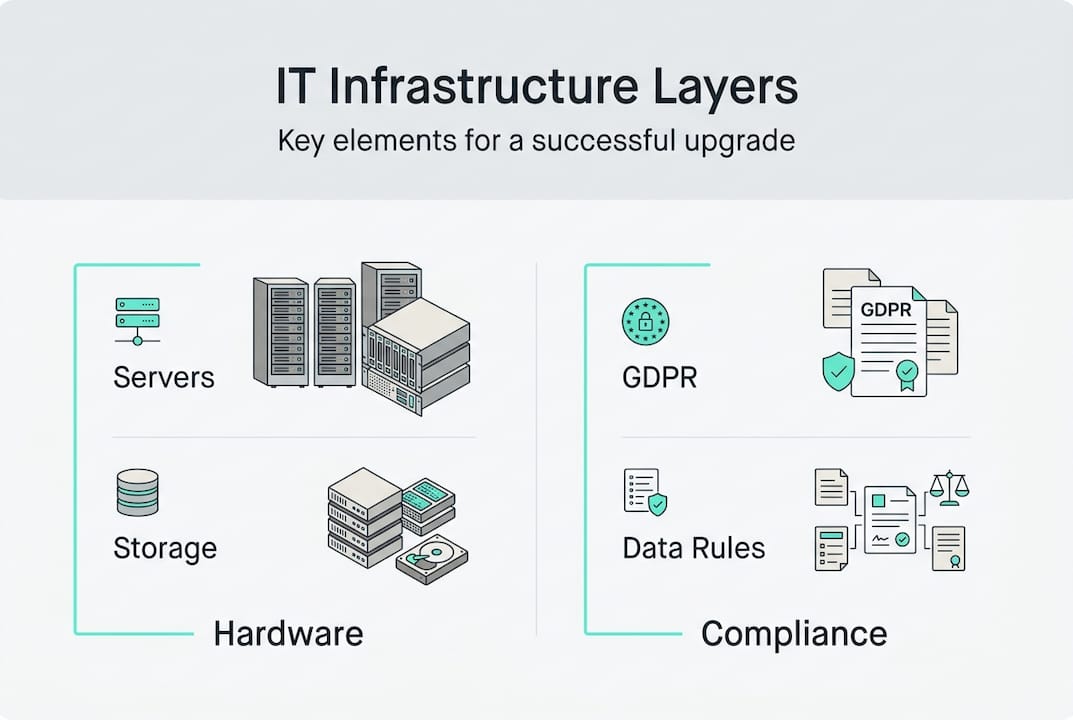
For UK enterprises, this audit must include a regulatory layer. GDPR compliance, UK data sovereignty rules, and sector-specific obligations (such as FCA requirements for financial services) all affect which systems can move to the cloud, which must stay on-premise, and how data flows must be documented. Understanding the range of infrastructure types you currently operate helps clarify which components carry the most risk.
Example audit categories and assessment criteria:
| Category | Assessment criteria |
|---|---|
| Hardware | Age, warranty status, performance benchmarks |
| Applications | Version currency, vendor support status, integration points |
| Connectivity | Bandwidth capacity, redundancy, latency metrics |
| Security systems | Patch levels, compliance alignment, incident history |
| Data storage | Residency location, backup frequency, recovery time objective |
Once your audit is complete, prioritize upgrades across these areas:
- Performance: Systems causing bottlenecks or failing SLA targets
- Security: Unpatched endpoints, expired certificates, outdated firewalls
- Compliance: Data handling gaps that expose the organization to regulatory risk
- Resilience: Single points of failure with no documented fallback
- Scalability: Components that cannot accommodate projected workload growth
Pro Tip: Use the Strangler Fig Pattern when replacing legacy systems. Rather than ripping out old technology in one move, you gradually build new capabilities alongside the existing system and route traffic incrementally. This approach, proven effective for zero-downtime deployments, reduces risk significantly while keeping operations stable throughout the transition.
Setting your upgrade strategy: phased, hybrid, or big-bang?
Once you know your starting point, the next step is selecting the right upgrade pathway for your organization. Two dominant approaches exist, and the differences between them are consequential.
A big-bang upgrade replaces or transforms infrastructure in a single, large-scale effort. It can be faster in theory, but it concentrates risk into one window and leaves little room for course correction. For most UK enterprises with complex legacy environments and compliance obligations, this approach is high-risk. The alternative, a phased upgrade, spreads change across multiple stages, allowing teams to validate each step before proceeding.
"Phased approaches are preferred by leading enterprises because they minimize operational impact, allow compliance checks at every stage, and give teams time to adapt."
Hybrid infrastructure, combining on-premise systems with public or private cloud, is increasingly the preferred architecture for UK businesses navigating data governance requirements. Hybrid cloud benefits include the ability to keep sensitive data within UK borders while leveraging cloud elasticity for non-regulated workloads. According to 6 strategies for accelerating IT modernization, phased upgrades minimize disruption while hybrid infrastructure actively supports compliance.
Phased vs. big-bang upgrade comparison:
| Factor | Phased upgrade | Big-bang upgrade |
|---|---|---|
| Risk level | Lower, spread over time | High, concentrated |
| Downtime exposure | Minimal per phase | High during cutover |
| Compliance checkpoints | Built into each stage | Single end-point review |
| AI readiness support | Incremental, sustainable | Immediate but fragile |
| Cost predictability | Easier to manage | Budget overruns common |
To plan a phased strategy effectively:
- Define the end-state architecture before beginning any work
- Segment your infrastructure into logical upgrade phases by risk and dependency
- Set measurable success criteria for each phase before moving to the next
- Identify which phases require external vendor or managed service support
- Build in a rollback plan for every phase, not just the final one
For organizations lacking in-house expertise, managed services can bridge the gap during the transition. The cloud's role in UK business transformation is no longer optional for enterprises aiming to remain competitive through 2026 and beyond. An external partner can also accelerate timelines where internal teams are stretched thin.
Planning and executing your infrastructure upgrade
With your upgrade strategy defined, it is time to move into careful planning and execution. Preparation here prevents the most common failure mode: projects that start with good intentions and collapse under poor coordination.

Begin by assigning clear ownership. Every workstream needs an accountable lead, not just a responsible team. Develop a detailed project timeline with hard milestones and buffer periods built in. Select vendors and service partners early, as procurement delays are a leading cause of schedule overruns. Refer to proven technology upgrade steps to structure your project plan with the right sequencing.
For execution, follow a structured phase model:
- Pilot phase: Deploy changes in a non-production environment, validate performance, security, and compliance
- Limited rollout: Expand to a small subset of users or workloads and gather real-world feedback
- Full rollout: Systematically migrate remaining systems using your validated approach
- Monitoring phase: Confirm KPIs are met and watch for unexpected behavior in the first 30 to 60 days
- Fallback readiness: Maintain rollback capability until the environment is fully stabilized
GDPR and data residency checks must be embedded at every stage, not bolted on at the end. Before any data migrates to a new environment, confirm where it will reside, who can access it, and how it is logged. These are not legal formalities; they are operational requirements. For enterprises considering investing in cloud solutions, this due diligence protects against costly post-migration compliance failures.
Pro Tip: Schedule major cutover events during verified low-traffic windows, typically early weekend mornings. Use canary, blue-green, and rolling deployments to ensure zero-downtime techniques reduce risk at every cutover point. These methods let you shift a small percentage of traffic to the new environment first, catch issues early, and expand gradually rather than flipping a single switch and hoping for the best.
Stakeholder communication is also non-negotiable during execution. Business unit heads, finance, legal, and end users all need appropriate visibility. Silence breeds resistance. Structured infrastructure tips for enterprise environments consistently identify poor communication as a top contributor to failed rollouts.
Validating success and ensuring ongoing improvement
After a successful rollout, it is critical to validate improvements and set up your infrastructure for continual advancement. Completing the migration is not the finish line. It is the starting point for a new operational baseline.
Validation should test directly against the KPIs established during your planning phase. Uptime targets, security compliance posture, application performance benchmarks, and data access latency are all measurable. If your post-upgrade environment does not improve on pre-upgrade baselines, you need to understand why before declaring success.
According to 6 strategies for accelerating IT modernization, modernization must be validated against performance, security, and compliance metrics, especially as AI adoption accelerates across UK enterprise environments.
Key elements of ongoing infrastructure management:
- Monitoring tools: Implement real-time dashboards covering uptime, throughput, and security events
- Incident response: Establish and test runbooks before the first incident occurs, not after
- Staff training: Ensure your team understands the new environment, including any cloud-native tooling
- Compliance reviews: Schedule quarterly reviews against GDPR, UK data sovereignty, and sector-specific obligations
- Vendor SLA tracking: Hold partners accountable using contractually agreed service levels
Building an AI-ready infrastructure is also now a business requirement, not an aspirational goal. Your upgraded environment should support scalable compute, low-latency data pipelines, and secure API integrations that AI tools depend on. Industry estimates suggest over 60% of UK mid-to-large enterprises now rely on hybrid infrastructure as their primary architecture for balancing compliance with resilience. Effective IT management strategies for 2026 treat continuous improvement as a permanent workstream, not a post-project activity.
The goal is a living infrastructure, one that you actively monitor, adapt, and improve rather than revisit only when something breaks. Optimizing infrastructure workflows consistently across business units separates enterprises that scale successfully from those that cycle endlessly through reactive fixes.
Why UK IT upgrades often fail: a practical viewpoint
Here is what the project management frameworks rarely say out loud: most IT infrastructure upgrade failures in UK enterprises are not technology failures. They are organizational failures dressed in technology language.
The pattern is consistent. A leadership team approves a budget based on an optimistic scope. Legacy dependencies turn out to be far more tangled than the initial audit suggested. Compliance requirements, particularly around UK data sovereignty, surface late and force expensive redesigns. Timelines slip, budgets expand, and stakeholders lose confidence.
The contrarian insight worth stating clearly: underinvesting in stakeholder engagement is more damaging than overengineering your technical architecture. We have seen technically sound upgrades collapse because business units were not consulted early enough and resisted the change at rollout. Technology is the easy part. Changing how people work is the hard part.
Cultural readiness matters as much as technical readiness. Before pursuing UK hybrid cloud strategies, assess honestly whether your organization has the skills, the change management capacity, and the leadership alignment to see a complex upgrade through. Accepting that complexity early, and planning for it rather than minimizing it, is what separates successful programs from expensive lessons.
Ready to future-proof your IT infrastructure?
This guide gives you the framework, but navigating a full-scale infrastructure upgrade across a UK enterprise environment takes more than a checklist. Regulatory complexity, legacy dependencies, and the pressure to deliver without disruption make expert support a practical necessity, not a luxury.

At Mighty Sky Tech, we work alongside IT decision-makers to de-risk upgrades, accelerate delivery timelines, and ensure every step meets UK compliance requirements. Whether you are planning your first phased migration or rearchitecting for AI workloads, our team brings the experience to keep your program on track. Explore our solutions or request a consultation today, and let's build infrastructure that works for the next decade.
Frequently asked questions
What is the Strangler Fig Pattern for IT upgrades?
It is a phased approach where new systems gradually replace legacy components alongside the existing environment, minimizing disruption. The Strangler Fig Pattern supports gradual replacement without forcing a risky full cutover.
How do phased upgrades benefit UK enterprises?
Phased upgrades reduce downtime, maintain business continuity, and allow compliance checks at every stage rather than a single end-point review. Phased upgrades minimize operational risk while giving teams time to adapt.
What role does hybrid cloud play in IT modernization?
Hybrid cloud lets enterprises keep sensitive data on-premise or in UK-based data centers while leveraging cloud scalability for other workloads. Hybrid infrastructure supports both compliance and flexibility simultaneously.
What are zero-downtime deployment strategies?
Canary, blue-green, and rolling deployments shift traffic gradually to new environments, catching issues before they affect all users. These zero-downtime techniques are considered best practice for enterprise upgrade execution.
How can UK businesses validate IT upgrade success?
Measure performance, security posture, and compliance metrics against pre-defined KPIs, then maintain a continuous improvement cycle. Validation and continuous improvement align directly with long-term modernization success.